
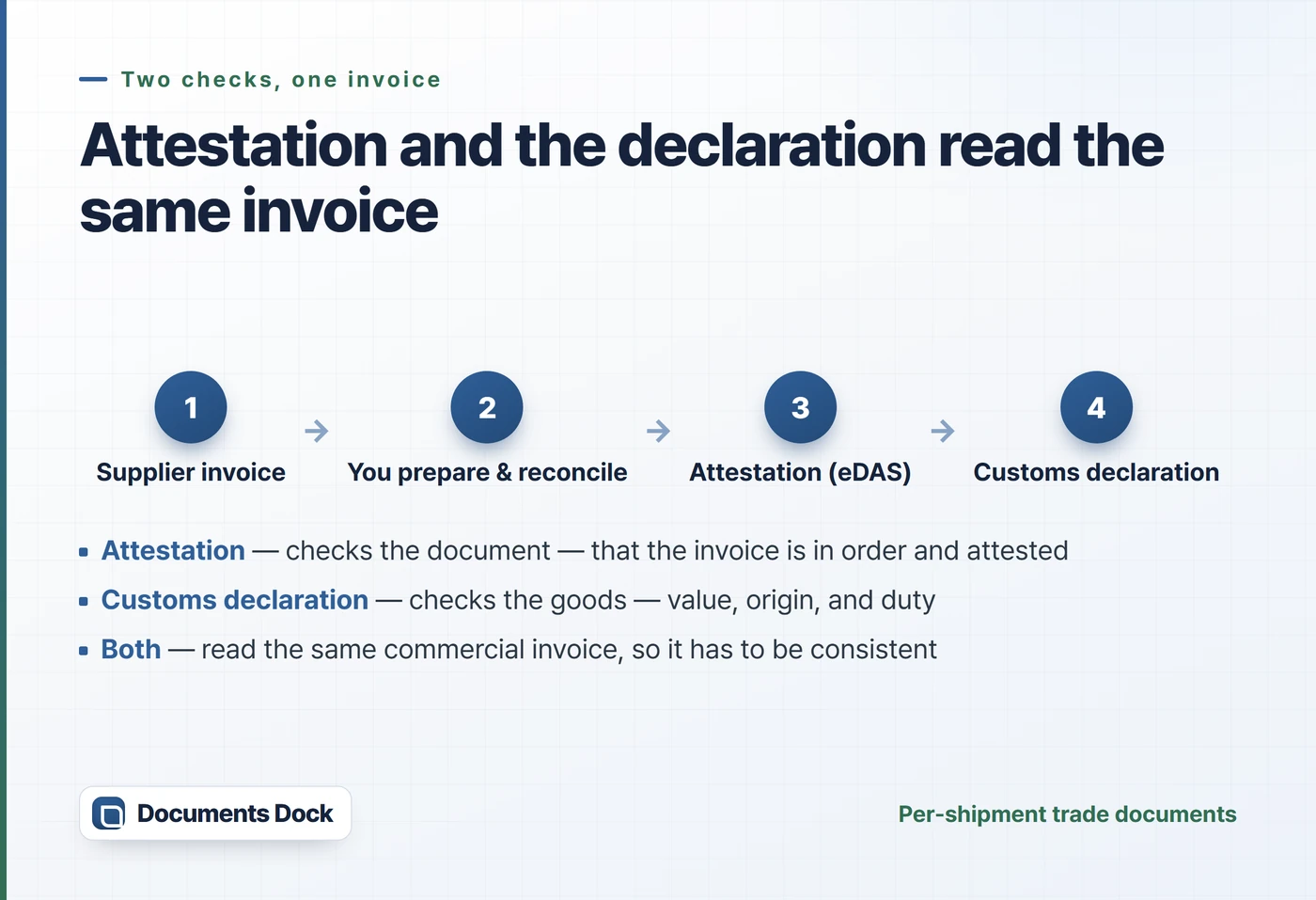
In the UAE, your commercial invoice is read twice — once when it's attested, and again when the goods are declared. Both read the same document, so it has to agree with itself before either step.
Two checks, one invoice
Importing into the UAE puts your commercial invoice in front of two different checks. Attestation — handled electronically through the Ministry of Foreign Affairs and International Cooperation (MOFAIC) electronic Document Attestation System (eDAS) — confirms that the invoice is in order and attested for use. The customs declaration, lodged through your customs broker, assesses the goods: their value, origin, and the duty owed.
They are separate steps with separate purposes, but they read the same commercial invoice. If the invoice isn't internally consistent, the gap shows up at whichever step comes second.
The document vs the goods
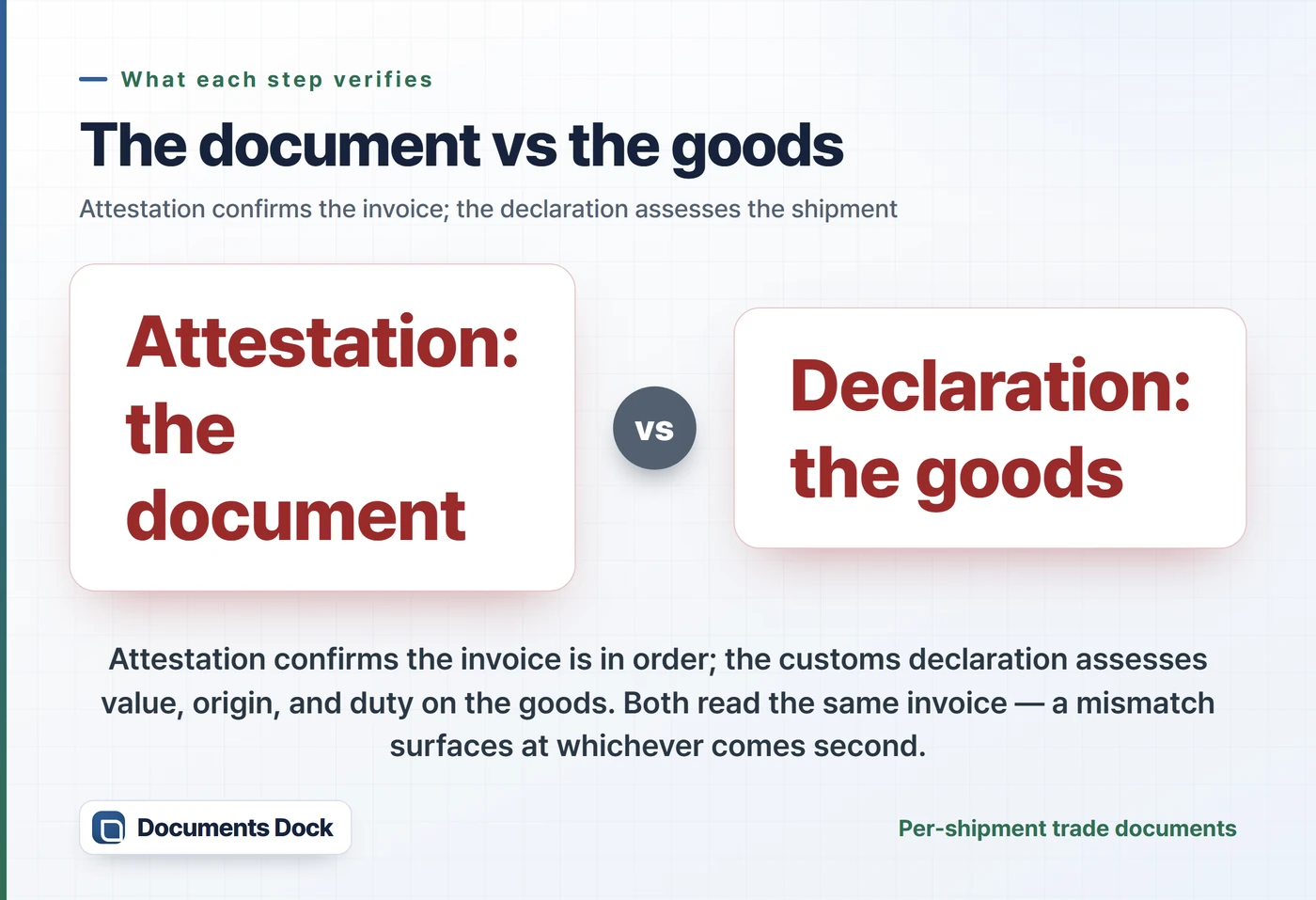
Attestation checks the document; the declaration checks the goods. Whether attestation applies to a given invoice — and any fee or deadline — depends on the shipment; confirm the current requirement with the Ministry of Foreign Affairs and International Cooperation (MOFAIC) or your customs broker.
What an attestation-ready invoice carries
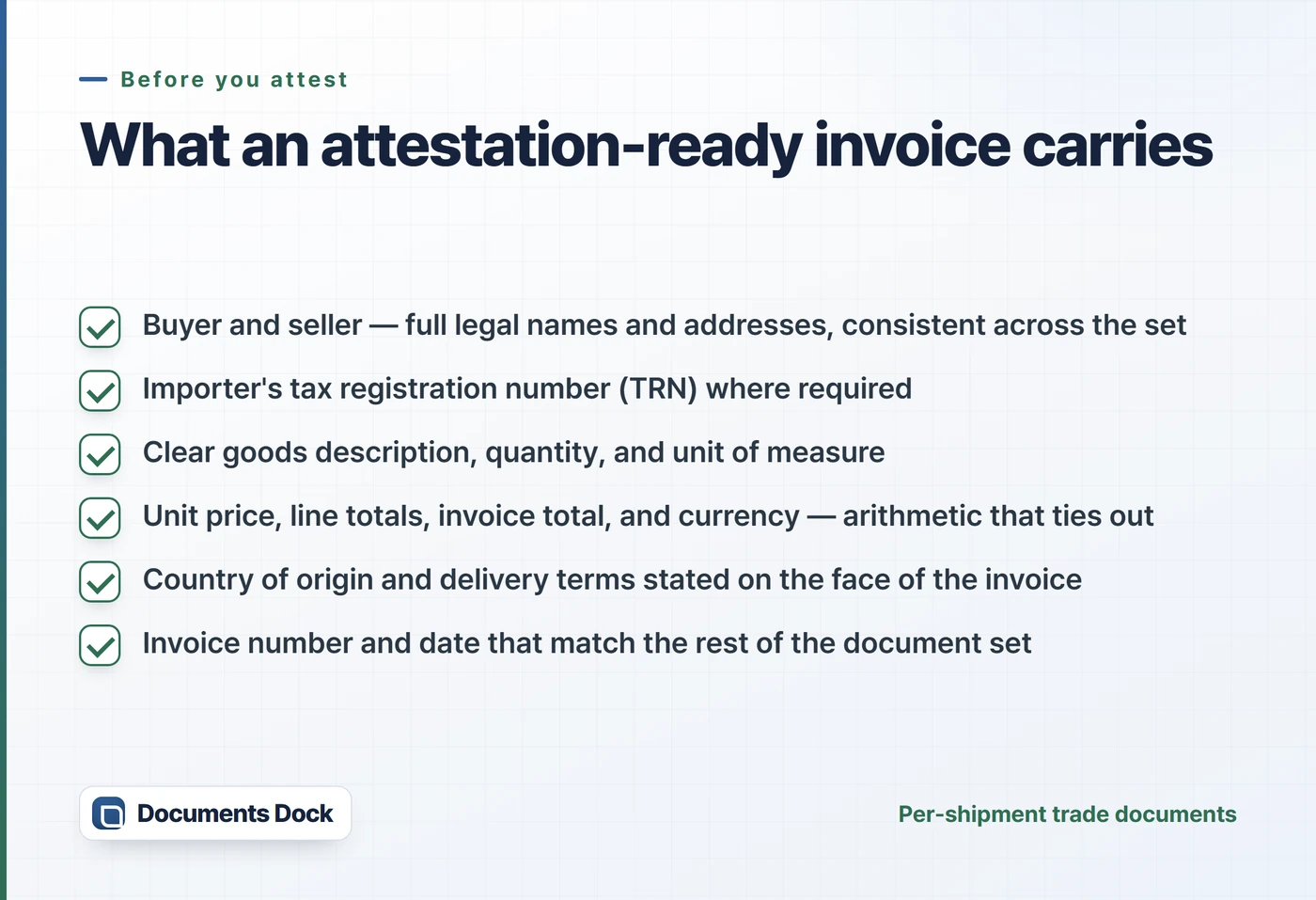
An attestation-ready invoice is simply a complete, consistent one. The fields that matter most:
- Buyer and seller — full legal names and addresses, consistent across the document set.
- The importer's tax registration number (TRN) where required.
- A clear goods description, quantity, and unit of measure.
- Unit price, line totals, invoice total, and currency — arithmetic that ties out.
- Country of origin and the delivery terms, stated on the face of the invoice.
- Invoice number and date that match the packing list and transport document.
A mismatch costs you twice
Because the UAE reads the invoice twice, a missing currency or an origin that doesn't match the certificate of origin costs you twice — once at attestation, once at the declaration.
The document vs the goods
It helps to keep the two questions apart. Attestation asks: is this a proper, attested invoice? The declaration asks: what are these goods worth, where are they from, and what duty applies? A consistent invoice answers both without contradiction.
Where importers get caught is treating attestation as a formality and the declaration as the "real" check — and then finding that the value or description the broker declares doesn't match the invoice that was attested.
In practice, that gap is avoidable. The invoice you attest and the invoice your broker declares from should be the same file: the same values, the same currency, the same parties, the same origin. When they are, attestation goes through cleanly and the declaration has nothing to contradict. When they aren't, you're correcting a document that has already been attested — which usually means stepping back and doing it again.
Prepare once, not twice
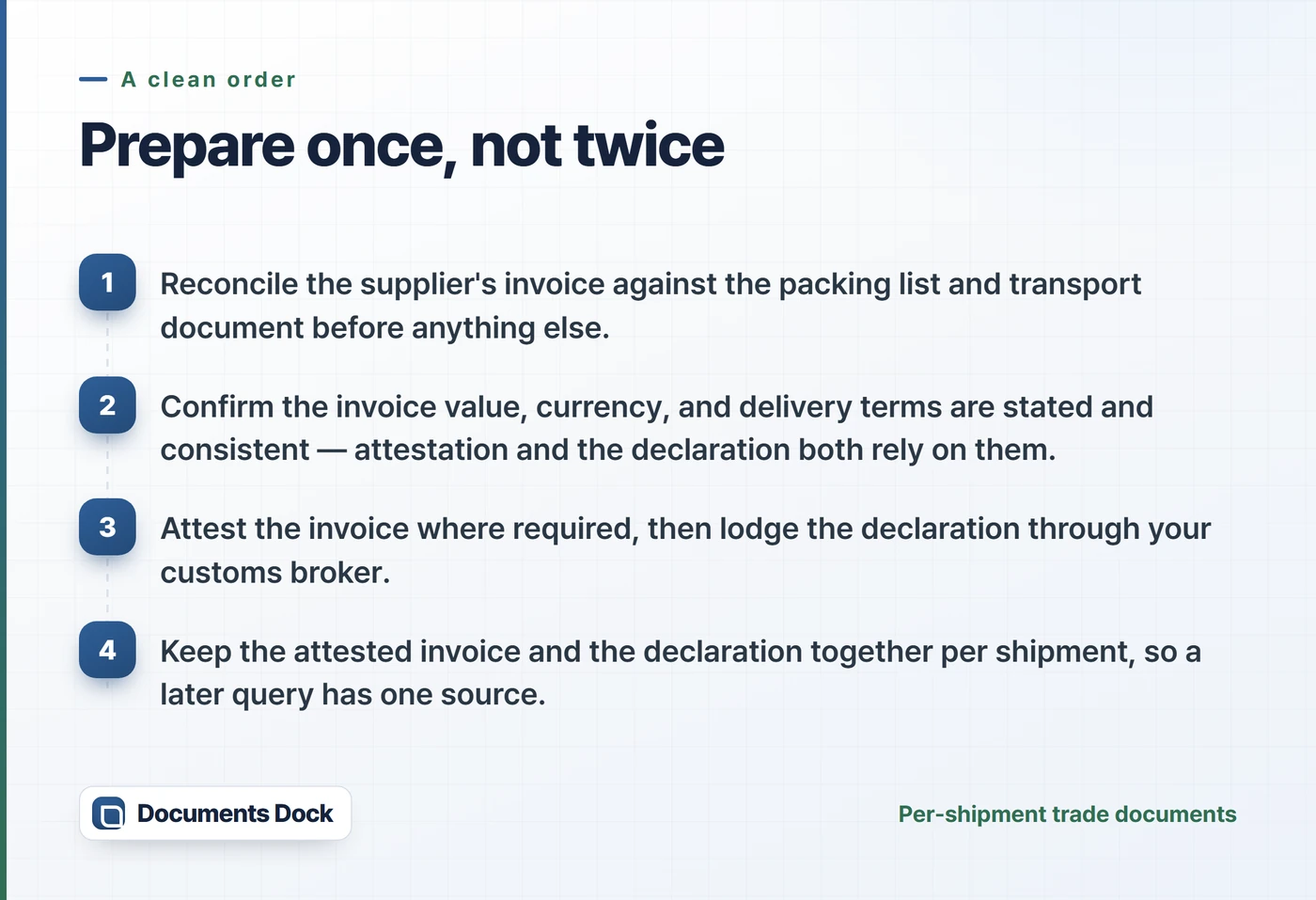
A clean order keeps you from redoing work:
- Reconcile the supplier's invoice against the packing list and transport document before anything else — quantities, weights, value, parties. Our note on where import documents get held walks through the cross-checks.
- Confirm the invoice value, currency, and delivery terms are stated and consistent — both attestation and the declaration rely on them.
- Attest the invoice where required, then lodge the declaration through your customs broker.
- Keep the attested invoice and the declaration together, per shipment, so a later query has a single source.
Prepare the invoice once
An invoice that's reconciled before attestation is the same invoice the declaration needs — no second round of corrections.
Before you attest or declare
Documents Dock keeps your commercial invoice, packing list, and issued copies organized per shipment — and flags where values, currencies, and parties disagree before you attest or declare. Keep the set in one place at documentsdock.com.
This is general information, not a compliance ruling. Whether attestation applies, and any fee, threshold, or deadline, depends on your goods and the current rules — confirm with the Ministry of Foreign Affairs and International Cooperation (MOFAIC) or a licensed customs broker.
- UAE Ministry of Foreign Affairs and International Cooperation (MOFAIC) — mofa.gov.ae (document attestation / eDAS)
- UAE Government portal — u.ae (attestation of documents)
- ICC, Incoterms 2020 rules — iccwbo.org/business-solutions/incoterms-rules/incoterms-2020