
When the Bureau of Customs holds up an import entry, the document usually isn't "wrong" — the numbers just don't agree across your papers.
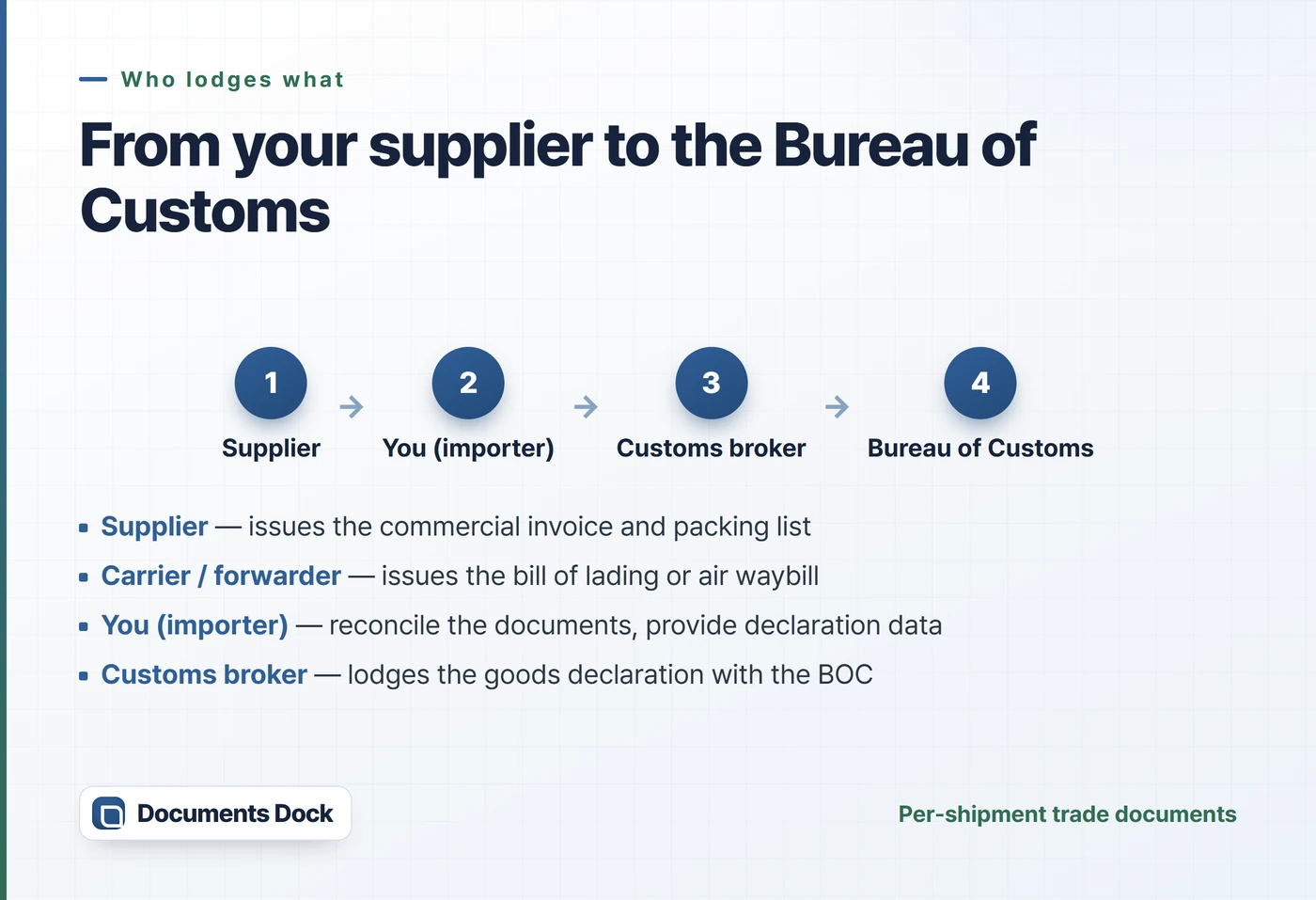
For most formal imports into the Philippines, a licensed customs broker lodges the goods declaration with the Bureau of Customs (BOC) on your behalf. But the broker files what you give them: the commercial invoice and packing list come from your supplier, and the bill of lading comes from the carrier or forwarder. When two of those papers describe the same shipment differently, the gap surfaces at clearance — not before. A little reconciliation before lodgement is what saves the back-and-forth.
Who lodges what
A formal import entry passes through several hands before it reaches customs. Knowing who produces each document — and who can fix it — tells you where a mismatch has to be caught.
The broker assembles and submits, and the importer generally needs to be accredited to import. But the broker can't invent a weight or reconcile a quantity that two of your documents state differently. For a fuller map of who issues each trade document, start there.
The broker files what you give them
A licensed customs broker lodges the entry — but they can't fix a value that disagrees across your documents. That reconciliation is yours, and it happens before the bundle reaches them.
The documents that must agree
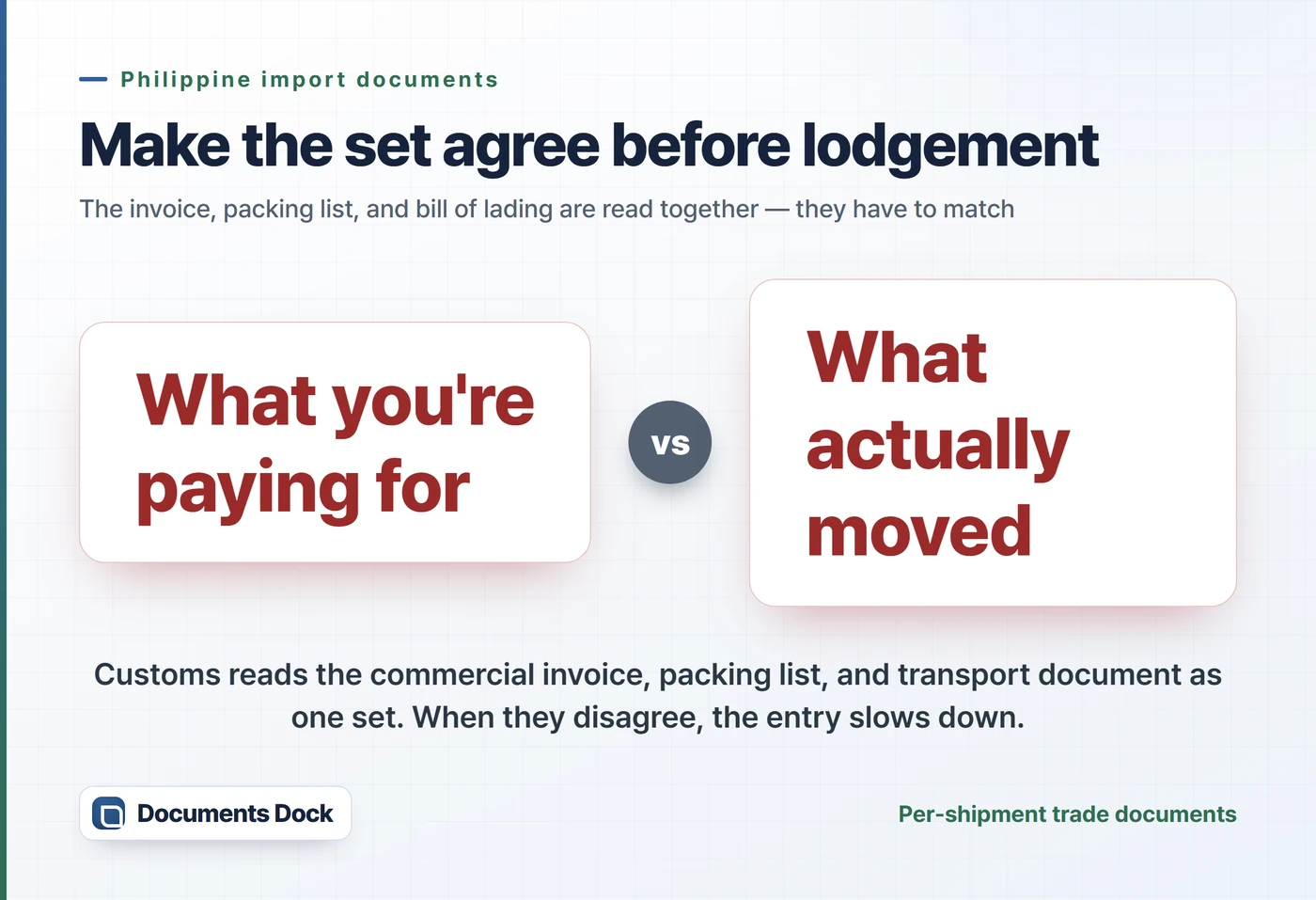
A formal import entry is read as a set, not as separate pages. The commercial invoice says what you're paying for; the packing list and the transport document say what actually moved. They have to describe the same shipment.
Each document carries a different slice of the same facts. Our commercial invoice guide covers the invoice field by field, and bill of lading vs air waybill explains the transport document — but for clearance, what matters is that they line up.
- Commercial invoice (CI): the parties, goods description, quantity, unit price, invoice value, and currency.
- Packing list (PL): how the goods are packed — piece and carton counts, and gross and net weight.
- Bill of lading or air waybill (B/L or AWB): the transport contract — consignee, marks, number of packages, and weight as carried.
- Certificate of origin (CO): needed when you claim a preferential tariff under a trade agreement; a non-preferential CO may be asked for other reasons.
Where the mismatches come from
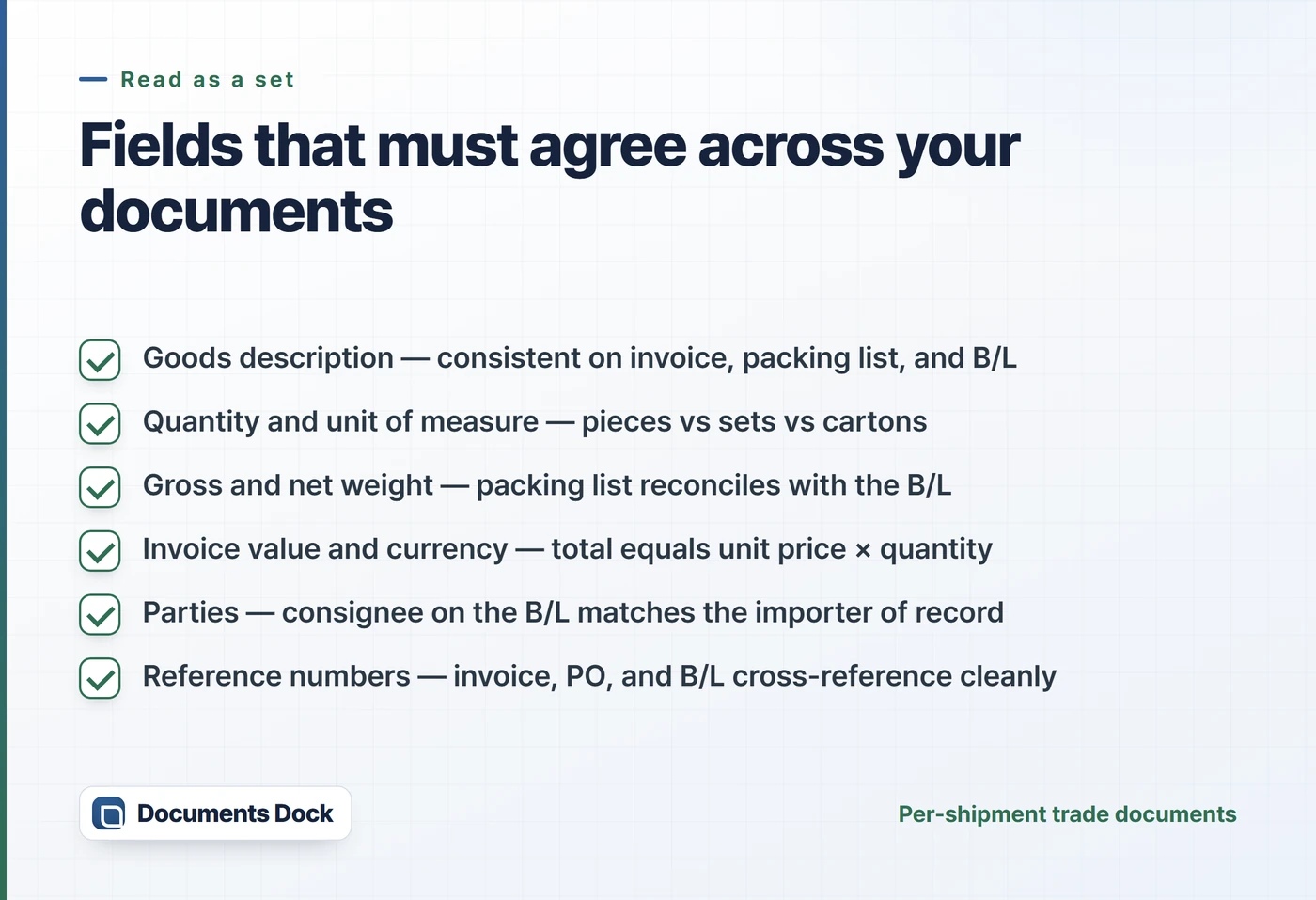
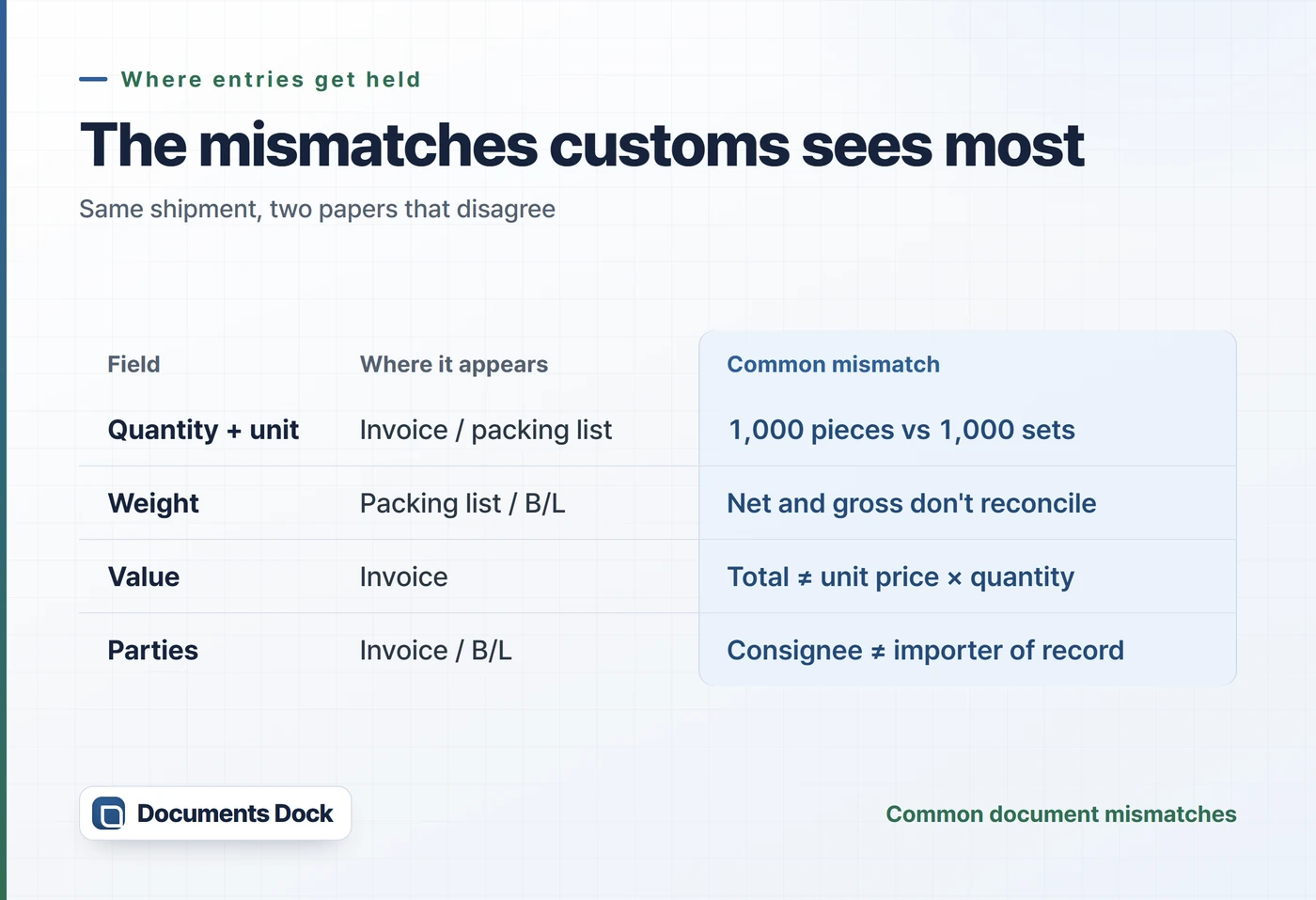
The same handful of fields cause most of the holds. None of them is exotic — they're the ordinary places where an invoice and a packing list drift apart.
- Quantity and unit of measure. "1,000 pieces" on the invoice and "1,000 sets" on the packing list are not the same line — a set of three pieces makes the two documents describe very different shipments.
- Gross vs net weight. The packing list carries both; the transport document usually carries gross. If your net weight and the bill of lading's gross weight can't be reconciled, expect a question.
- Invoice value and currency. A currency left off, or a total that doesn't equal unit price × quantity, stands out.
- Party names. The consignee on the bill of lading should be consistent with the buyer on the invoice and the importer of record.
"Pieces" and "sets" are not the same quantity
A unit-of-measure mismatch between the invoice and the packing list is one of the most common reasons a shipment gets questioned. Fix it on the source document, not in the declaration.
Reconcile the set before your broker lodges it
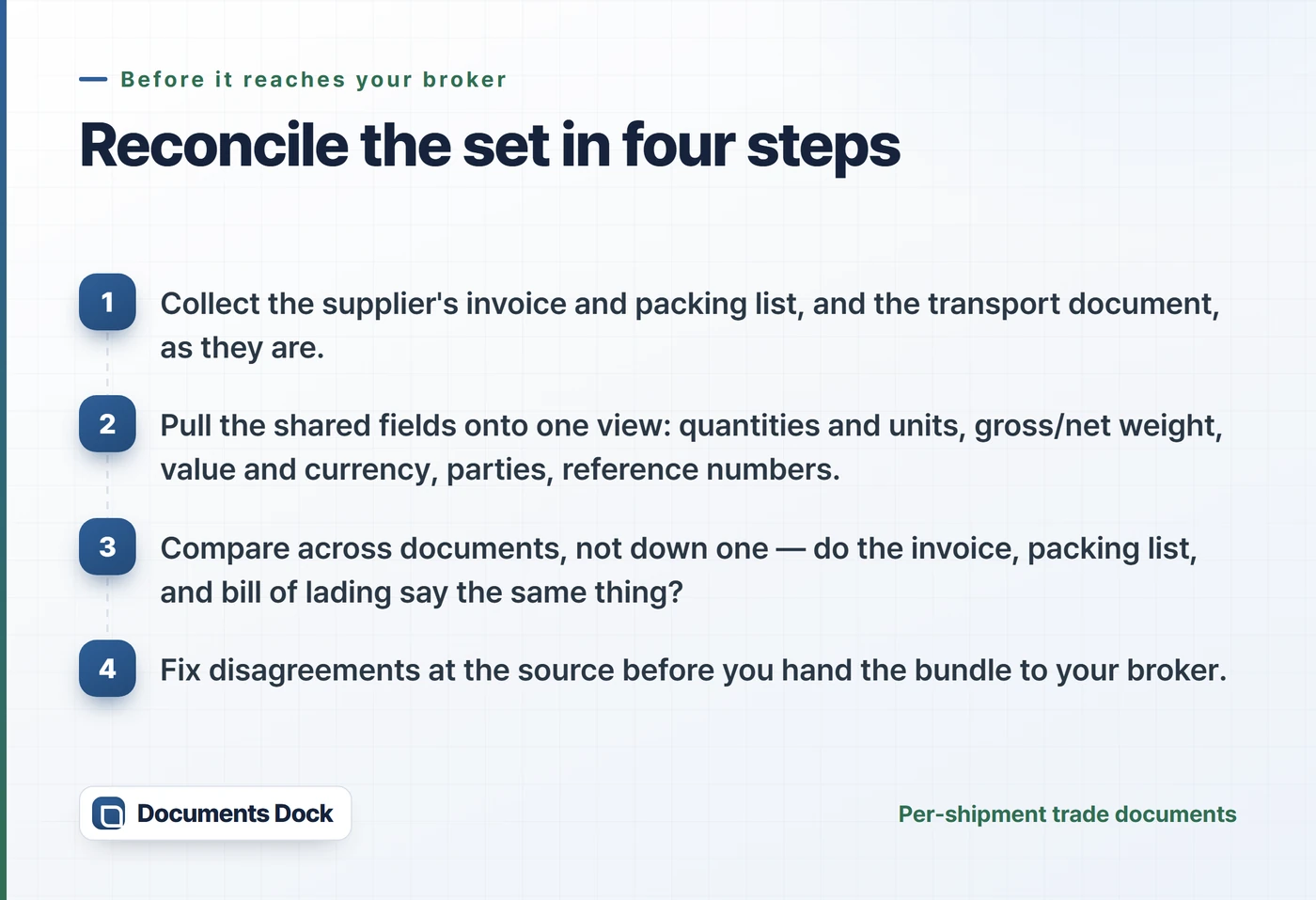
None of this needs a new system — it needs the set to agree before it leaves your hands. A practical order:
- Collect the supplier's invoice and packing list, and the transport document, as they are.
- Pull the shared fields onto one view: quantities and units, gross and net weight, value and currency, parties, and reference numbers. Check that the invoice value and currency are consistent with your delivery terms — whether freight and insurance are included in the price — so your broker can verify the customs value.
- Compare across documents, not down one. The question is never "is the invoice right?" — it's "do the invoice, packing list, and bill of lading say the same thing?"
- Fix disagreements at the source — ask the supplier to correct the invoice or packing list — before you hand the bundle to your broker.
Catch it at your desk
That last step is the difference between catching a mismatch at your desk and hearing about it from customs after the entry is lodged.
Before you submit
Before you submit, Documents Dock flags where quantities, amounts, and weights disagree across your documents — so the bundle your broker lodges already agrees with itself. Keep your CI, PL, transport documents, and issued copies organized per shipment at documentsdock.com.
This is general information, not a compliance ruling. Whether a specific entry, duty, accreditation, or certificate applies depends on your goods, the countries involved, and your terms of sale — confirm with a licensed customs broker or the Bureau of Customs.
- Philippine Bureau of Customs — customs.gov.ph
- U.S. International Trade Administration (ITA), Philippines Country Commercial Guide — trade.gov/country-commercial-guides/philippines-import-requirements-and-documentation
- ICC, Incoterms 2020 rules — iccwbo.org/business-solutions/incoterms-rules/incoterms-2020