
For a Malaysian import, the K1 declaration is only as clean as the documents behind it.
A Malaysian K1 import declaration is built from four documents: the commercial invoice, the packing list, the transport document (bill of lading or air waybill), and any certificate of origin or import permit the goods require. A licensed customs agent lodges that set as Customs Form No. 1 with the Royal Malaysian Customs Department (RMCD).
The declaration itself is a form; what fills it is your commercial paperwork. A customs agent turns your invoice, packing list, and transport document into the K1 that goes to the customs authority — so the quality of the declaration is really the quality of the set you started with. Get that set right and the form takes care of itself.
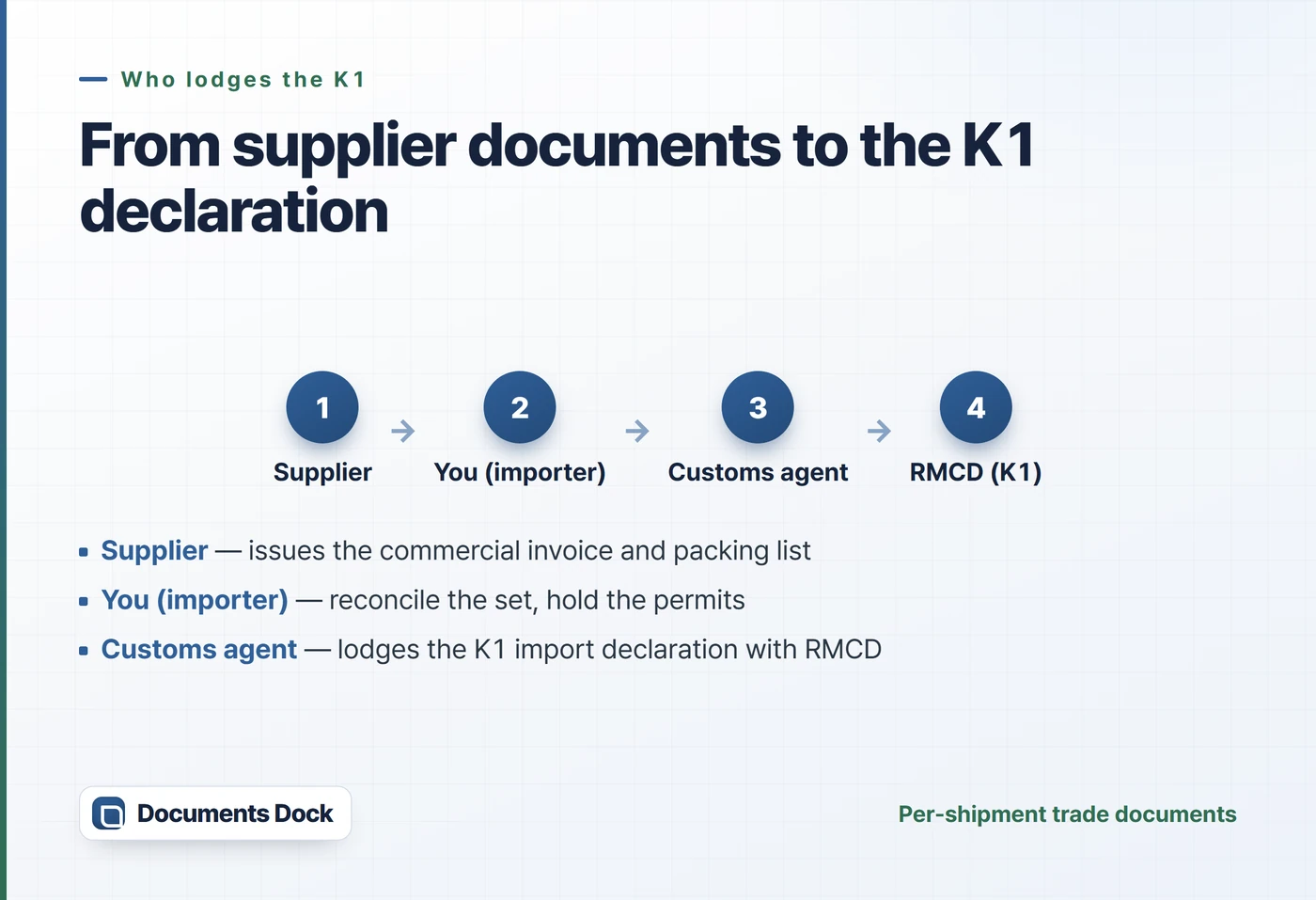
Who lodges the K1 in Malaysia?
For most commercial imports into Malaysia, the goods are declared to the Royal Malaysian Customs Department (RMCD) on a Customs Form No. 1 — the K1 import declaration — usually submitted by a licensed customs agent or forwarder acting for the importer.
The agent prepares and lodges it, but from the documents you hand over. The commercial invoice and packing list come from your supplier; the bill of lading or air waybill comes from the carrier or forwarder; any permit or certificate comes from the relevant authority. The agent assembles and files — they can't reconcile a figure that two of your documents state differently.
That division of labour is easy to misread. It's tempting to treat the agent as the one responsible for the declaration, but the agent works from your inputs. If the invoice value and the packing-list quantities don't agree, the agent can flag it — but they can't decide which number is right. That decision, and the fix, sits with you and your supplier.
What documents do you need for a K1 declaration?
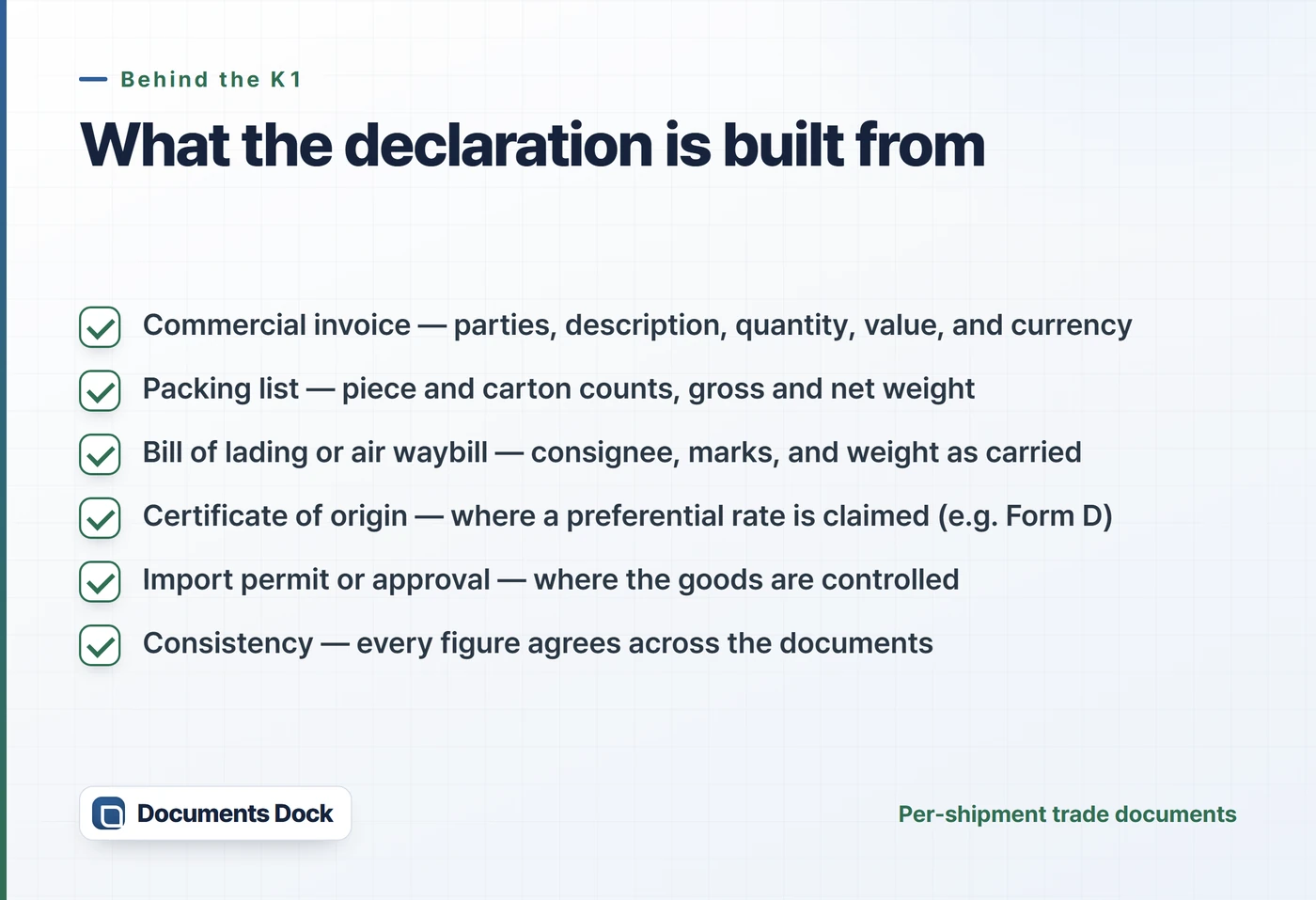
A K1 needs the commercial invoice, the packing list, the transport document (bill of lading or air waybill), a certificate of origin where a preferential rate is claimed, and an import permit where the goods are controlled. The declaration draws its facts from that set — so each document has to describe the same shipment: the value and description on the invoice, the quantities and weights on the packing list, and the details on the transport document should line up before any of them supports a K1. Where a preferential rate is claimed, the certificate of origin has to match the invoice it is issued against. It is worth checking these against each other early, while the supplier can still amend a document without holding up the shipment.
- Commercial invoice — the parties, goods description, quantity, value, and currency.
- Packing list — piece and carton counts, and gross and net weight.
- Bill of lading or air waybill — the consignee, marks, number of packages, and weight as carried.
- Certificate of origin — where you claim a preferential rate under a trade agreement, such as a Form D under the ASEAN Trade in Goods Agreement.
- Import permit or approval — where the goods are controlled and an approval is required before importation.
What slows a K1 declaration down?
Most hold-ups trace to the documents, not the declaration form itself. None of the usual ones is exotic — they are the ordinary places a document set drifts apart, and each gives the agent, or RMCD, something to query before the goods can move. Catching them at your desk is cheaper than answering them after arrival:
- A quantity or unit that doesn't match between the invoice and the packing list.
- A weight on the packing list that can't be reconciled with the transport document.
- A value or currency that isn't stated consistently, or a total that doesn't add up.
- A preferential claim without the matching certificate of origin, or a controlled item without its permit in hand at the time of import.
The certificate and the permit have to be in hand
Typically, a preferential rate needs its certificate of origin, and a controlled item must have its permit before import — a common, avoidable hold-up. Confirm the specifics with your customs agent or RMCD.
Reconcile before the agent files
It also helps to know which documents your particular goods need before the shipment leaves. A preferential rate that isn't claimed with the right certificate simply isn't given; a controlled item that arrives without its approval waits. Neither is a customs "error" — it's a document that wasn't ready. Building the habit once is cheaper than unpicking a query later, especially when the same suppliers and the same goods come back shipment after shipment. The fix is to hand the agent a set that already agrees:
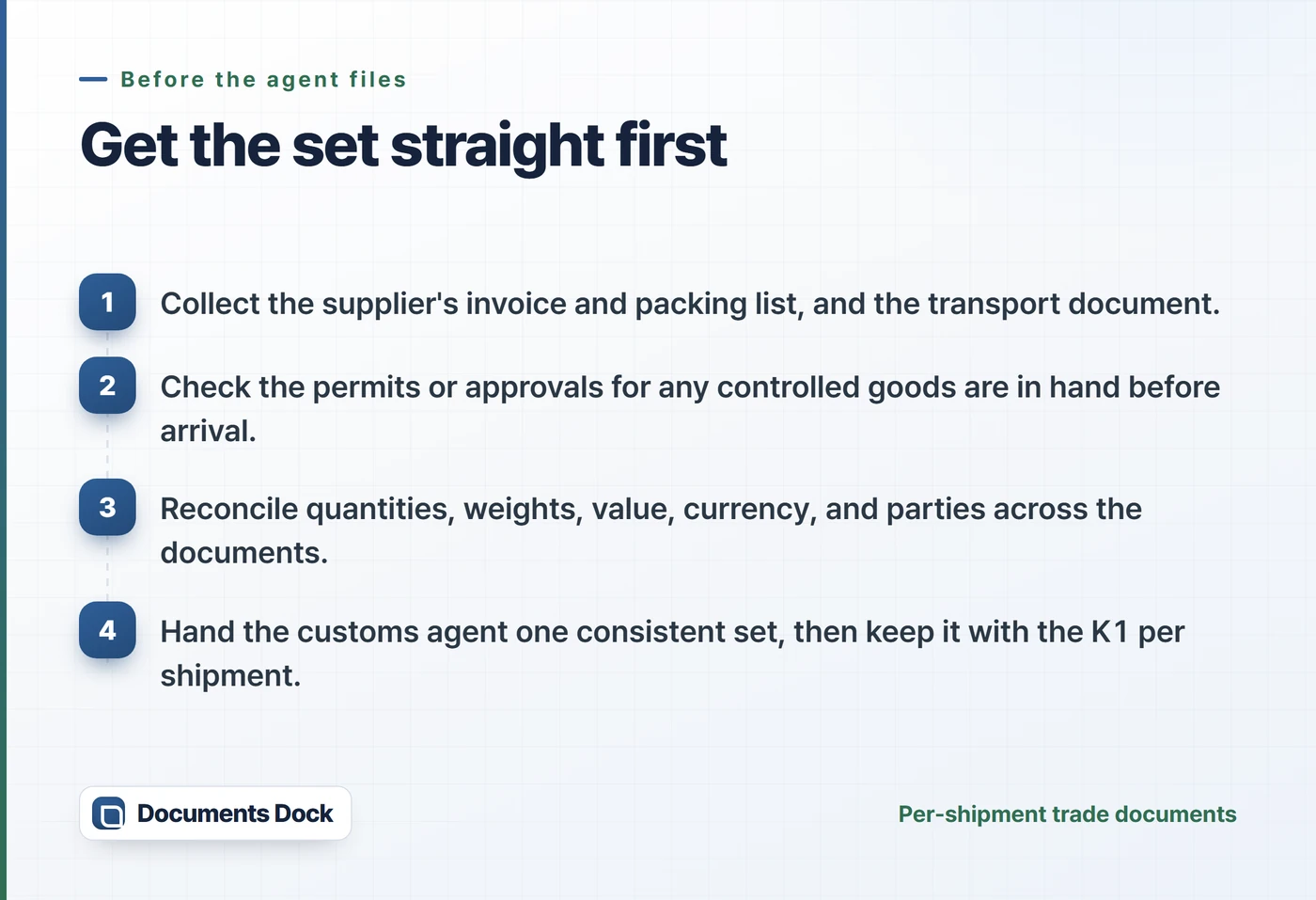
- Collect the supplier's invoice and packing list, and the transport document, as they are.
- Check that any permit or approval for controlled goods, and any certificate of origin for a preferential claim, is in hand before arrival — the same discipline as any customs submission.
- Reconcile quantities, weights, value, currency, and party names across the documents.
- Hand your customs agent one consistent set, then keep it with the K1, per shipment, so a later query has a single source.
The agent lodges what you give them
A set that agrees with itself before it reaches the agent is a K1 with nothing to query. The payoff is a quieter clearance — little for the customs authority to question, and a shipment that moves on its own timetable rather than a correction cycle.
Before your agent files
Documents Dock keeps your commercial invoice, packing list, transport documents, and issued copies organized per shipment — and flags where quantities, values, and parties disagree before your agent files the K1. Keep the set in one place at documentsdock.com.
This is general information, not a compliance ruling. Which documents, permits, or certificates your shipment needs depends on your goods, their origin, and the current rules — confirm with a licensed customs agent or the Royal Malaysian Customs Department.
- Royal Malaysian Customs Department (RMCD) — customs.gov.my (import declaration / Customs Form No. 1)
- Ministry of Investment, Trade and Industry (MITI), Malaysia — miti.gov.my (Approved Permits for selected controlled items); other permits may be issued by the relevant sectoral ministries
- ASEAN, ASEAN Trade in Goods Agreement (ATIGA) Form D — asean.org