In Hong Kong, the desk that reads your documents most closely isn't customs — it's the bank.
That surprises importers who expect a customs-heavy process. Hong Kong's free port runs the other way: the goods move easily, and the paperwork gets its close reading where the payment is decided.
A free port moves the checkpoint
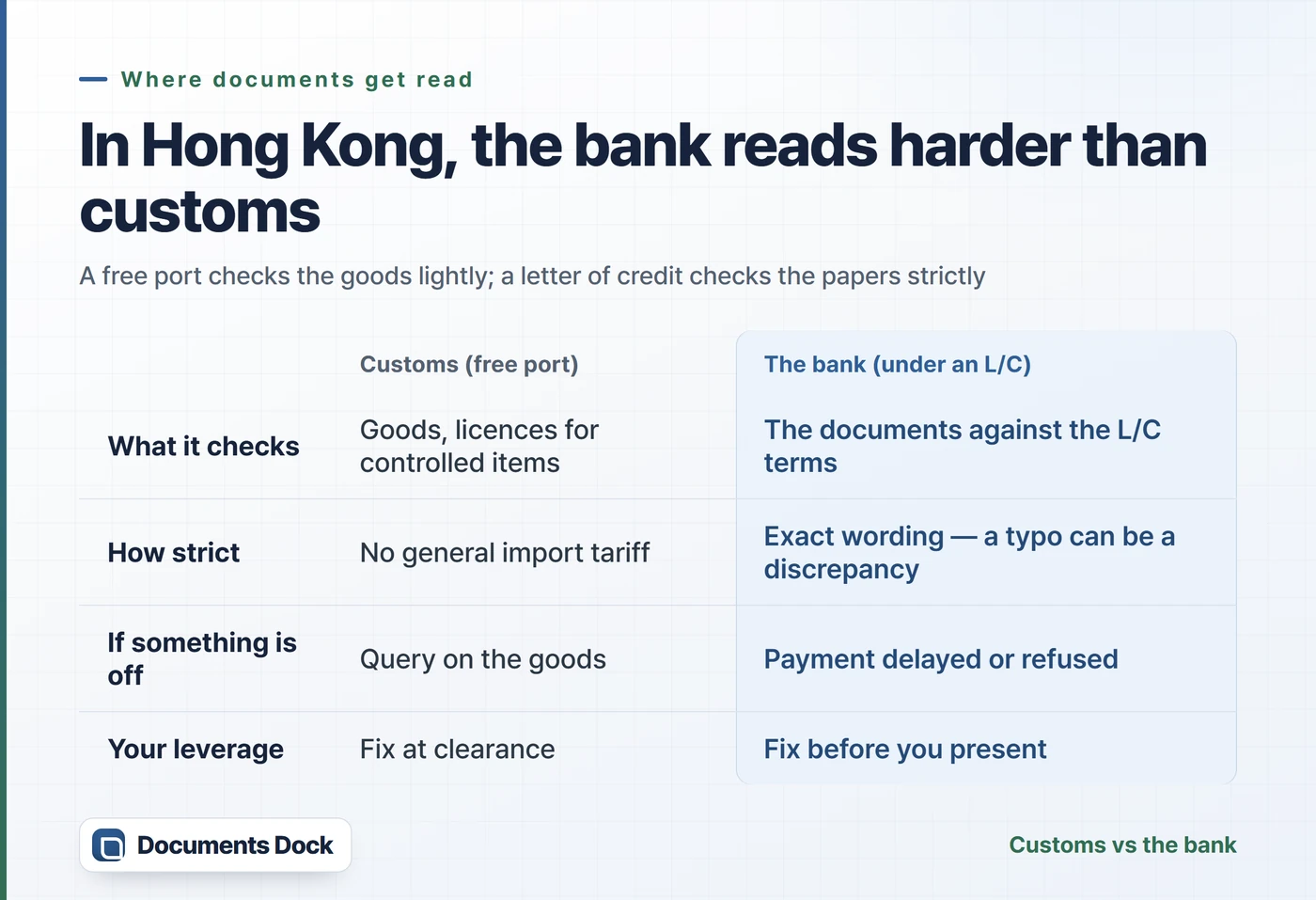
Hong Kong does not levy a general customs tariff on most imports or exports, and there is no routine duty assessment on ordinary goods. Customs still enforces licences and controls on specific categories — strategic commodities, dutiable goods like liquor and tobacco, and prohibited items — but for a typical shipment, customs is not where your commercial invoice and bill of lading get scrutinised line by line.
That scrutiny moves to whoever is paying. When that's a letter of credit, it's the bank.
That single fact reshapes where your attention should go. In a market where customs waves most ordinary shipments through, the document risk doesn't disappear — it moves downstream to the party holding the money. It helps to treat the bank, not the customs desk, as the reader you are preparing the documents for.
Under an L/C, the bank reads the papers
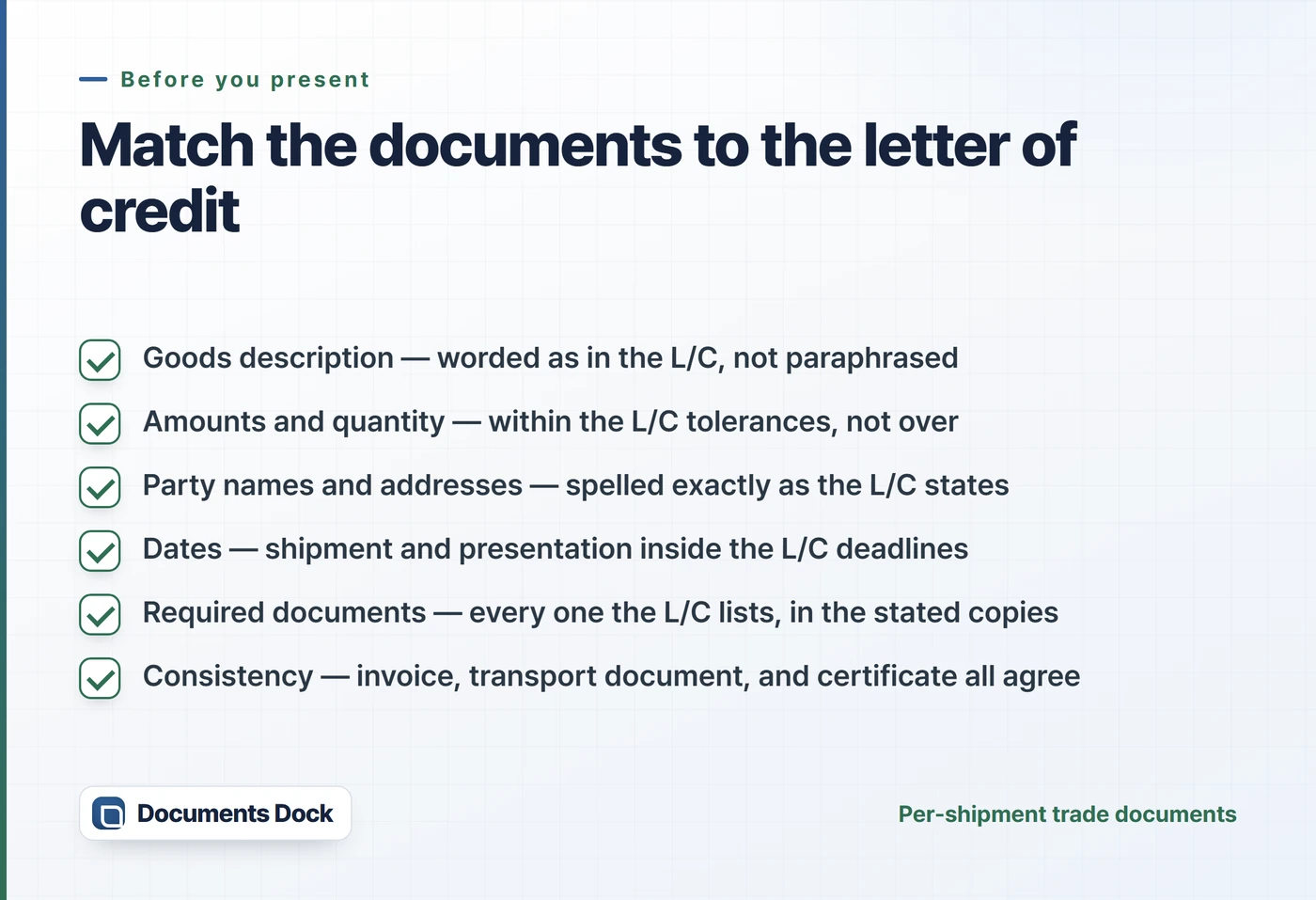
A letter of credit is a bank's promise to pay against documents that comply with the credit's terms — commonly examined under the ICC's UCP 600 rules. The bank does not inspect the goods; it examines the documents. If the documents don't match the L/C — a description that's paraphrased instead of quoted, an amount over the credit, a name spelled differently, a document missing or presented late — the bank can treat it as a discrepancy and withhold or refuse payment until it's resolved or waived.
None of this is the bank being difficult. A letter of credit substitutes the bank's promise for the buyer's, and the only thing the bank has to go on is the paperwork — so it holds the documents to the exact terms it agreed to pay against. That's why "close enough" doesn't clear: the bank isn't judging your shipment, it's judging whether the papers match the credit.
The goods can be perfect and payment still stalls
Banks examine documents, not cargo — a discrepancy is a document problem, not a shipment problem. The goods can arrive exactly as agreed while the payment waits on a wording mismatch.
Re-export and back-to-back L/Cs
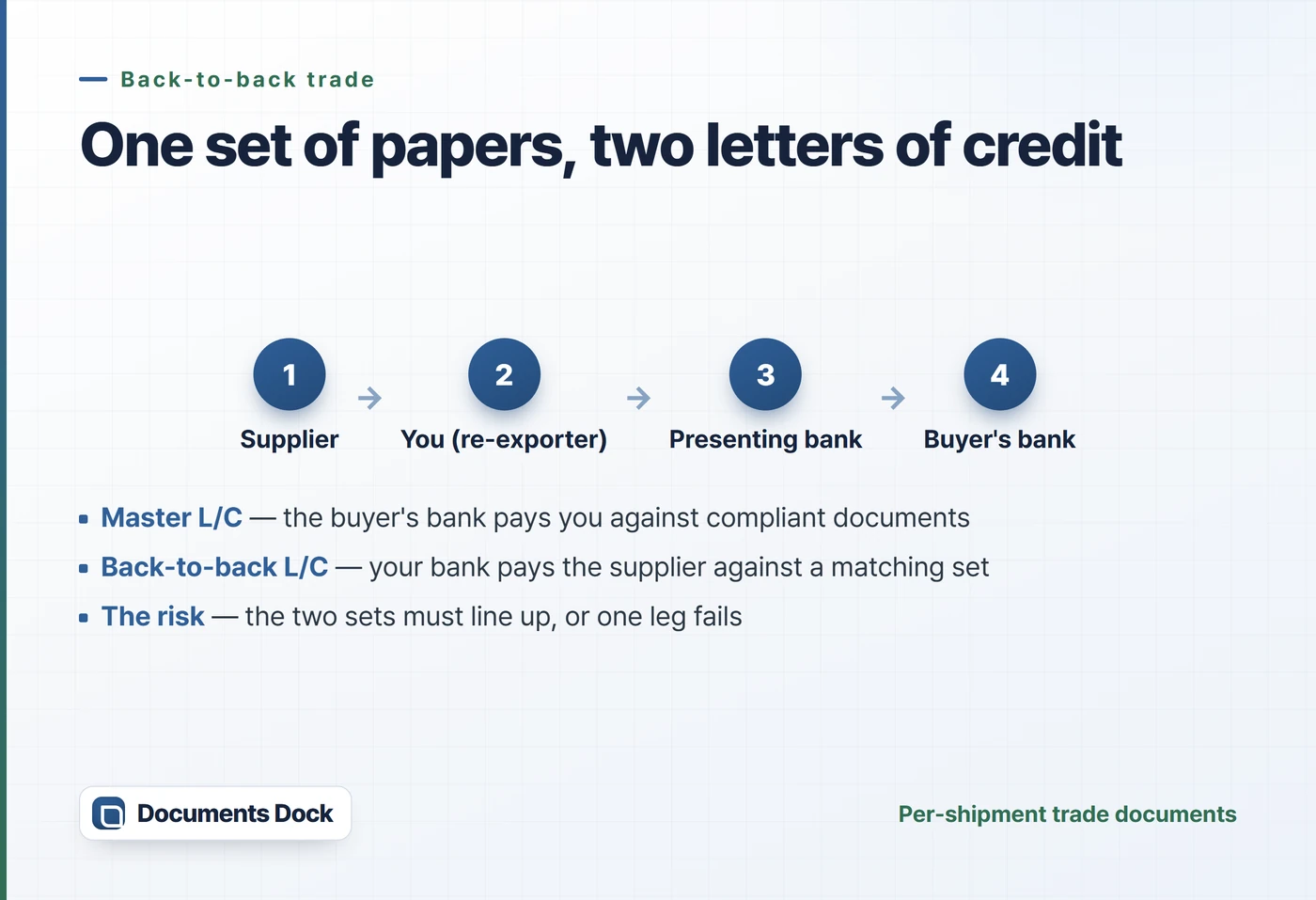
Hong Kong's trade is heavily re-export: goods bought from one country and sold to another, often financed with a back-to-back letter of credit. You receive a master L/C from your buyer's bank and open a back-to-back L/C with your own bank to pay your supplier. Now two sets of documents have to work — the set you present to get paid, and the set your supplier presents to be paid. If the two don't line up — different descriptions, quantities, or terms — one leg of the deal can fail even though the goods moved fine.
A common failure is a goods description that the master L/C spells one way and the supplier's invoice spells another. Your buyer's bank pays you only if your documents match the master L/C; your bank pays the supplier only if theirs match the back-to-back. Align the wording across both credits at the start and the two presentations fall into place. Leave it to the end, and a single word can strand one side of a deal that has otherwise gone perfectly.
Match the documents to the L/C first
There is nothing clever about avoiding a discrepancy — it's proofreading the documents against a contract. But it is the step most often skipped, because the papers "look right," and looking right and matching the credit are different tests. Only the second one gets you paid. The way through is to build the documents from the L/C, not from habit:
- Read the L/C terms first — the goods description, the amounts and tolerances, the shipment and presentation dates, and the exact list of documents required.
- Draw or collect each document to the L/C's wording, not from memory or a previous shipment.
- Cross-check the set against itself — invoice, transport document, and any certificate must agree, the same way they would for any customs submission.
- Present within the deadline. A late presentation, or one short a required copy, is a discrepancy on its own.
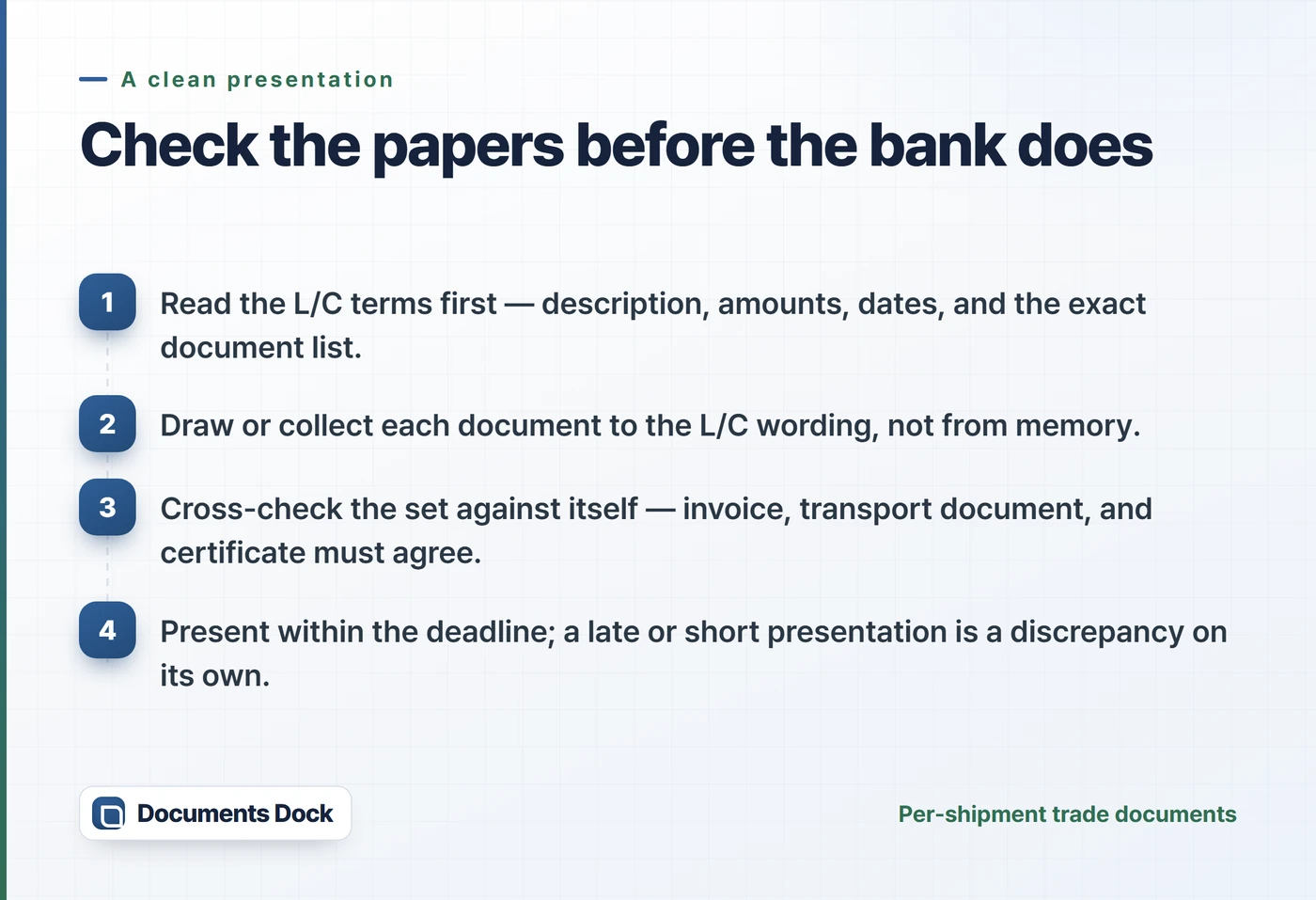
Check the papers before the bank does
Every discrepancy you catch at your own desk is one the bank won't bounce back to you.
Before you present
Documents Dock keeps your invoice, transport documents, certificates, and issued copies together per shipment — and flags where descriptions, amounts, and parties disagree before you present. Keep the set in one place at documentsdock.com.
This is general information, not legal or banking advice. Whether a document complies with a specific letter of credit depends on its exact terms and the applicable rules — confirm with your bank or a trade finance specialist.
- ICC, Uniform Customs and Practice for Documentary Credits (UCP 600) — iccwbo.org
- Hong Kong Trade and Industry Department — free port and import/export licensing overview — tid.gov.hk
- Hong Kong Customs and Excise Department — dutiable commodities and controls — customs.gov.hk