
Ask whether you need a certificate of origin and the answer starts with a question back: is someone claiming a lower duty rate, or asking you to prove where the goods were made? Two documents share the name.
A certificate of origin is a document stating the country where goods were produced. You need one when a duty preference under a trade agreement is being claimed, or when the buyer, a letter of credit, or the destination's own import rules ask for proof of origin. Otherwise most shipments travel without one.
Settle the branch first, then read only that branch's instructions. This guide covers the fork and the route to a document on each side. It does not cover how to classify your goods (the HS code on your commercial invoice), and it is not an import checklist.
Preferential or non-preferential: which one are you being asked for?
A preferential certificate of origin is evidence that goods qualify under a specific trade agreement's rules of origin, and it exists so the importer can claim a reduced or zero rate of duty at the border.
A non-preferential certificate of origin is evidence of where goods were made, issued without reference to any trade agreement, and it exists because a buyer, a bank, or the destination's import rules asked for proof.
They reach you from different directions. A preferential proof is one you and your buyer choose to produce, because the duty saved is the whole reason it exists. A non-preferential certificate is demanded of you — by the buyer's purchase terms, by a documentary credit (a letter of credit), or by the destination's rules. On this branch your own customs authority is rarely the party asking.
The preferential branch can be the opposite: several agreements run approved- or registered-exporter schemes administered by the exporter's own authority, and until you are on that register a self-certification you sign is not valid — so on that side, check whether you have to join something before you can sign anything.
A shipment can need both, one, or neither — and neither is the usual outcome. Even then the country of origin still goes on your commercial invoice: declaring origin and certifying it are separate acts.
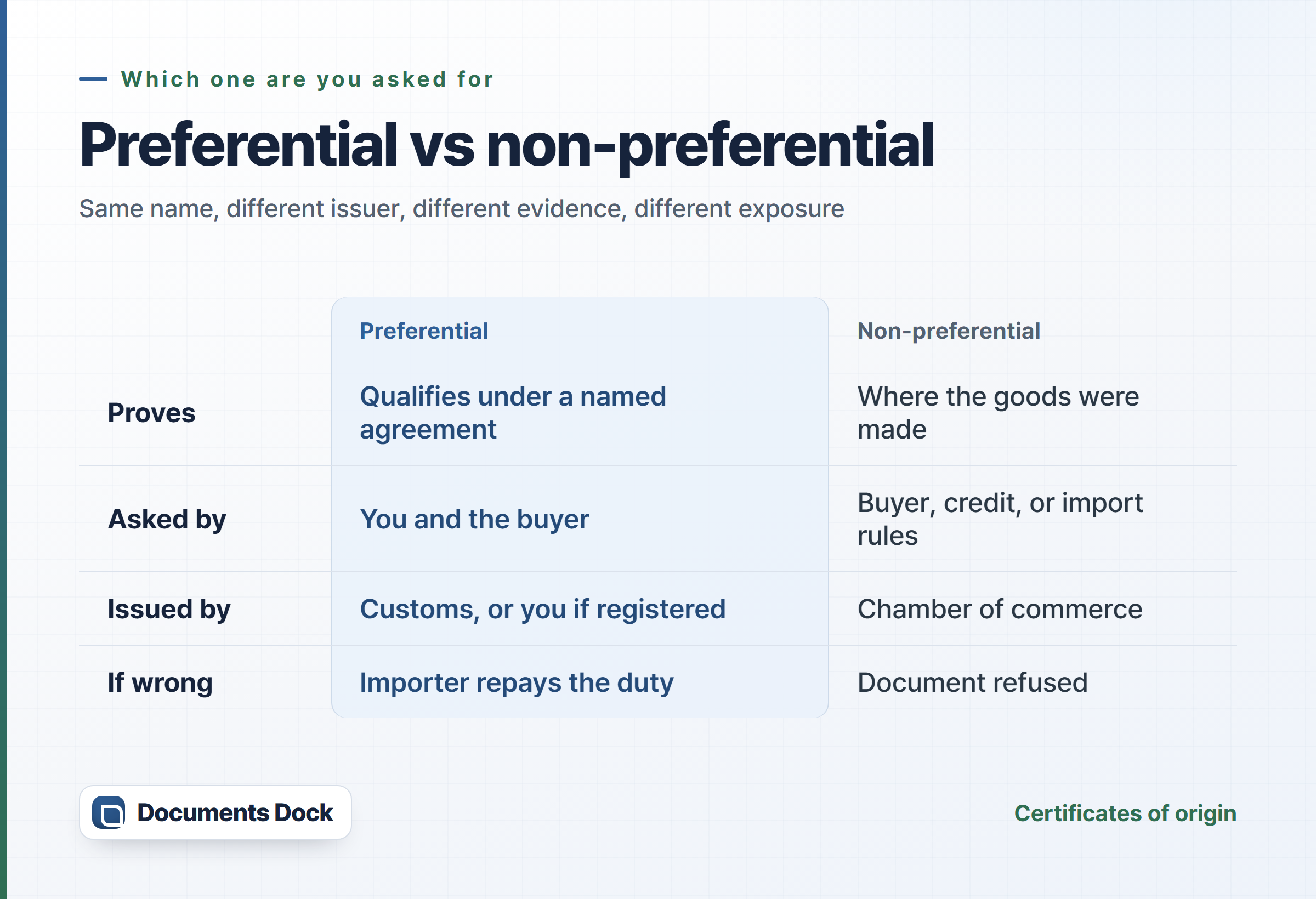
One word decides the branch
Preferential means duty is at stake; non-preferential means only the fact of origin is. The issuer, the evidence, and the cost of an error differ on each side of that line.
Do your goods actually qualify for the preference?
Ask this before you request anything. A preferential proof is only worth having if the goods meet the rules of origin of the agreement being claimed under. The document asserts origin; it does not create it.
Rules of origin are written agreement by agreement: two agreements covering the same pair of countries can set different tests for the same goods, because the test travels with the agreement, not with the product. Broadly, goods qualify if they were wholly obtained in one country or substantially transformed there.
The claim is made at import, which is why the exposure sits with the importer. If a later verification finds the goods did not qualify, the preference is disallowed and the importer faces the duty that should have been paid, usually with interest and sometimes penalties. Verifications arrive long after release, and both sides normally have to keep the records behind a claim for years.
- **Wholly obtained** — grown, extracted, or produced entirely in one country.
- **Substantially transformed** — a change of tariff classification, a value threshold, or a processing rule, as that agreement defines it.
- **Minimal operations** — repacking, labelling, simple mixing or assembly, which typically do not confer origin. Where goods ship from is not where they originate.
- **Supporting evidence** — bills of materials, production records, and supplier declarations for inputs you did not make yourself.
A wrongly claimed preference lands on the importer
An exporter who signs an origin declaration lightly is writing a cheque somebody else has to honour. Where origin is unclear, entering at the standard rate and claiming later, if the agreement allows it, is easier to unwind.
How do you get a preferential proof of origin?
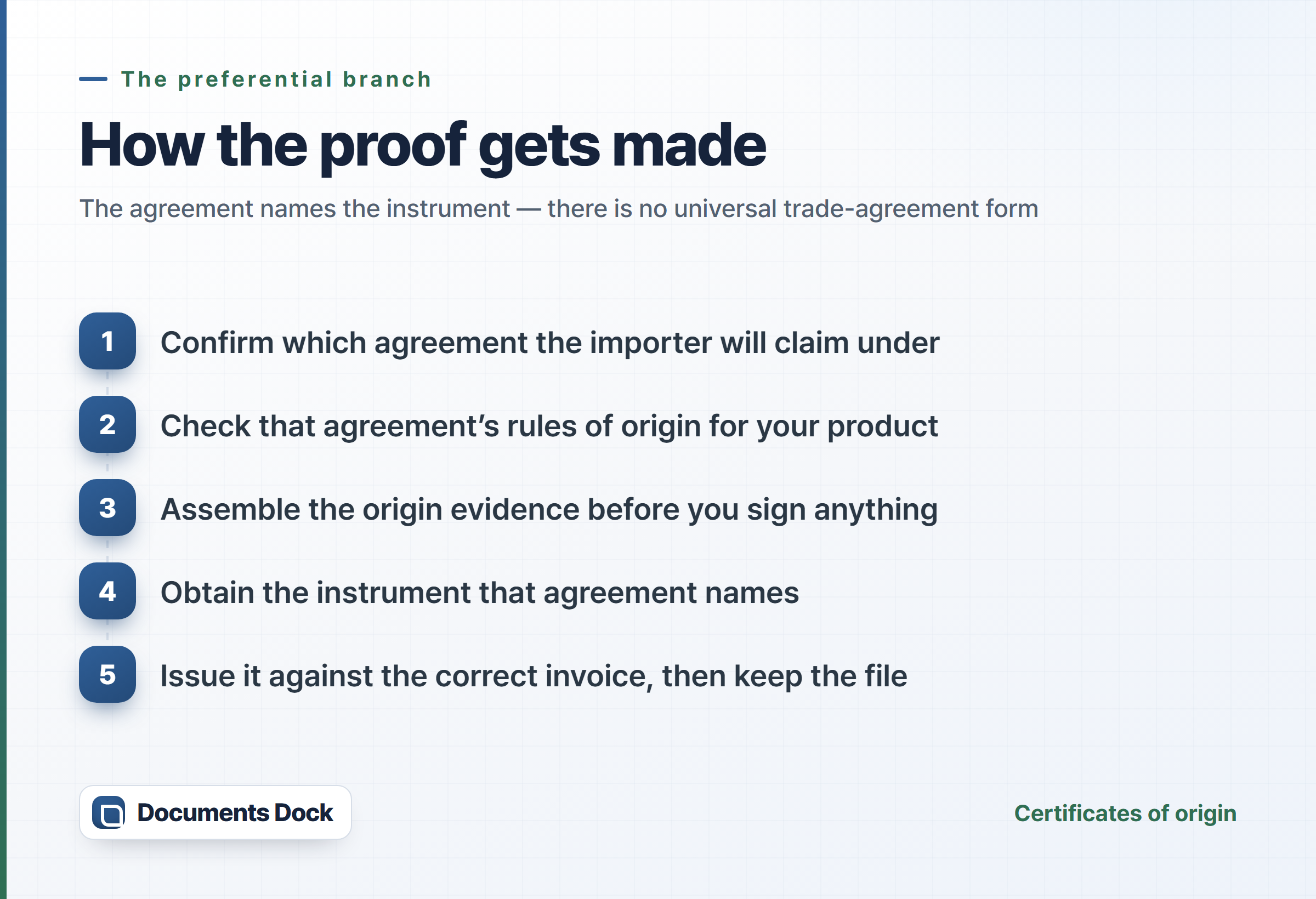
The agreement names the instrument. There is no universal trade-agreement form: exporters lose time chasing a form that belongs to a different agreement, or fielding a request for one that does not exist in that lane.
Two broad routes exist. On the first, an authority issues or endorses the proof: under a number of the European Union's preferential agreements, the exporter applies for a EUR.1 movement certificate that the exporting country's customs authority endorses. Even inside one bloc the instrument moves — the EU's newer agreements lean on a registered exporter's statement instead.
On the second, the trader certifies origin themselves, sometimes only after registering: under the EU's Registered Exporter (REX) system — used for its Generalised Scheme of Preferences and for certain agreements — a registered exporter makes out a statement on origin on a commercial document, while a certification under the United States–Mexico–Canada Agreement (USMCA) has no prescribed form at all: it is a set of minimum data elements, completed by the exporter, the producer, or the importer, and it can sit on the commercial invoice or on a separate signed statement.
Where an agreement uses a model like that, the proof is text you write — no authority stamps it and nothing is returned to you, so there is no form to chase and no queue to join. Which model applies is stated by the agreement, not by custom.
A request for an “FTA certificate” with no agreement named cannot be filled. And do not ask a chamber of commerce for a trade-agreement certificate — chambers are the other branch's route.
- Confirm in writing which agreement the importer will claim under.
- Check that agreement's rules of origin for your specific product, not the category.
- Assemble the origin evidence before you sign anything.
- Obtain the instrument the agreement names: apply to the issuing authority, or register so you can self-certify.
- Issue the proof against the correct invoice, get it to the importer before entry, and keep the file for the retention period.
How do you get a non-preferential certificate of origin?
This branch is more uniform. A non-preferential certificate is normally completed by the exporter and certified by a chamber of commerce or another authorised body in the exporting country. Many now issue electronic certificates a bank or customs office can verify online.
Expect to submit it with the commercial invoice and, where the chamber asks, a manufacturer's or supplier's declaration. The chamber checks that the origin claimed is supported, then stamps and returns the certificate against a fee. What counts as support, how fast the work is turned around, and what it costs vary by chamber and by country, so ask yours before your first application.
The certificate is read next to the rest of the bundle, so its details have to match: consignee, goods description, marks and numbers, quantities, and the invoice number it quotes. Mismatches are a routine reason for refusal; those fields are set out in how to write a commercial invoice and how to write a packing list.
The requirement can sit in the credit, the purchase order, or the sales contract, and the three do not always agree — read all of them before you apply. Where a credit calls for the certificate, read its wording literally: it may name the issuing body, the number of originals, and the exact origin phrasing it accepts, and a certificate correct in substance is still refused for not matching.
Some destinations then require legalisation on top — an embassy stamp confirming the certifying body is one they recognise, a separate errand with its own timetable (invoice attestation: when you need it, and who stamps it).

Treat the buyer's ask as a specification
The requirement belongs to whoever asked for it. Where a purchase order or a credit names the issuing body or the wording, an equally reputable body's differently worded certificate is still refused.
What gets a certificate of origin refused?
The generic failures — a signature from a body without standing, a lapsed validity window, a superseded invoice number — are set out in why customs rejects your documents. These three belong to origin alone.
- **The wrong instrument** — a form belonging to a different agreement, or a self-certification made out by an exporter who had to register first.
- **Issued after the goods moved**, without checking what your agreement allows — some agreements permit a proof to be issued after shipment only when it carries the retrospective endorsement they specify; others provide no deferred route at all, in which case the preference is lost rather than late. The deferred-issue rule sits in the agreement text, and it is worth reading before you ship rather than after.
- **A third-party invoice** — goods invoiced by someone other than the party named on the certificate, a trading arm or a buying agent, say — used where the agreement makes no provision for one. Where an agreement does provide for it, it normally has to be declared in a named field on the certificate; where it does not, no wording on the form cures it and the workable answer is a direct invoice from the party the certificate names.
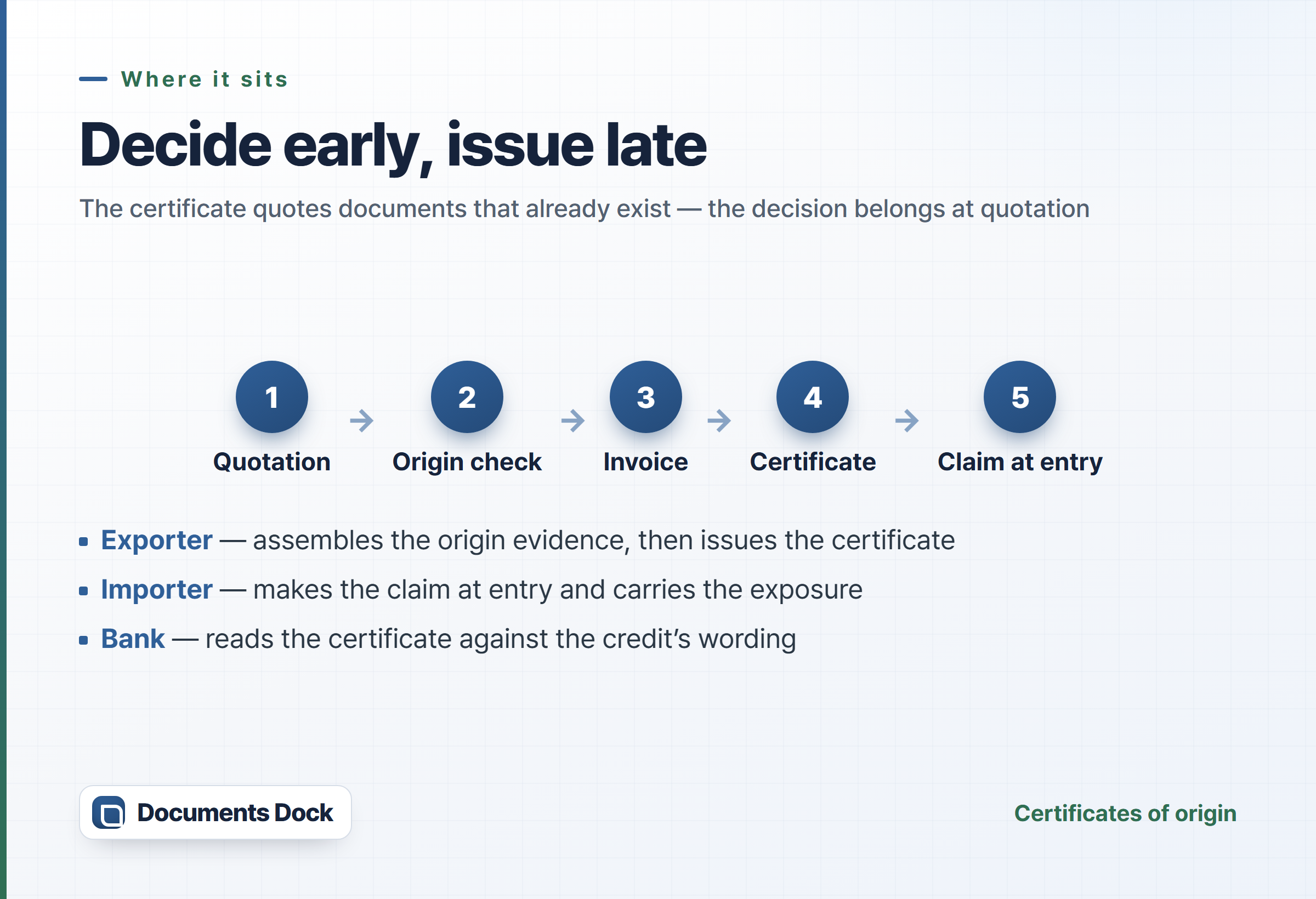
Decide early, issue late
A certificate of origin is issued late and quotes documents that already exist, so the decision belongs at quotation rather than at packing. The evidence behind a preferential claim is assembled long before anyone types a certificate, and a proof issued against a superseded invoice is worth nothing. Where it sits in the sequence is mapped in the full export document set, in order.
An origin claim has to hold up years after the goods clear. Documents Dock files the certificate, the invoice it names, and the evidence behind the claim as a single shipment record you can reopen the day a verification asks — documentsdock.com.
Sources and scope
This is general information, not a compliance ruling. Whether a certificate is required, which agreement your goods qualify under, and which body has standing to certify them depend on the goods, the countries, and your terms of sale — confirm with a licensed customs broker or the relevant authority before you claim a preference.
- World Trade Organization (WTO) — Agreement on Rules of Origin (wto.org)
- World Customs Organization (WCO) — Rules of origin, overview and instruments (wcoomd.org)
- ICC World Chambers Federation — Certificates of origin (iccwbo.org)
- European Commission, Taxation and Customs Union — Origin of goods, movement certificates and the Registered Exporter system (taxation-customs.ec.europa.eu)
- U.S. Customs and Border Protection — USMCA certification of origin (cbp.gov)