
What is commercial invoice attestation?
A commercial invoice can leave your office finished and still be turned away at the other end — not for what it says, but for whose stamp it lacks.
Commercial invoice attestation is the official confirmation — by a chamber of commerce and, for some destinations, a foreign embassy — that your invoice is genuine and issued by a real exporter. Certain countries, mainly in the Gulf and the wider Arab League, will not clear imported goods until the invoice carries these stamps.
Attestation and legalisation are used almost interchangeably here: both mean an authority has stamped your invoice to vouch that it is real. Destinations that ask for it are guarding against forged values and shell exporters, and setting a trusted basis for the duty they will charge.
This guide covers when attestation applies, who stamps the invoice, and the order the stamps go in. It does not cover the UAE's electronic route in detail — for that, see the UAE eDAS invoice attestation guide — or how to prepare the invoice itself, which how to write a commercial invoice walks through.
Do you need your invoice attested? The destination fork
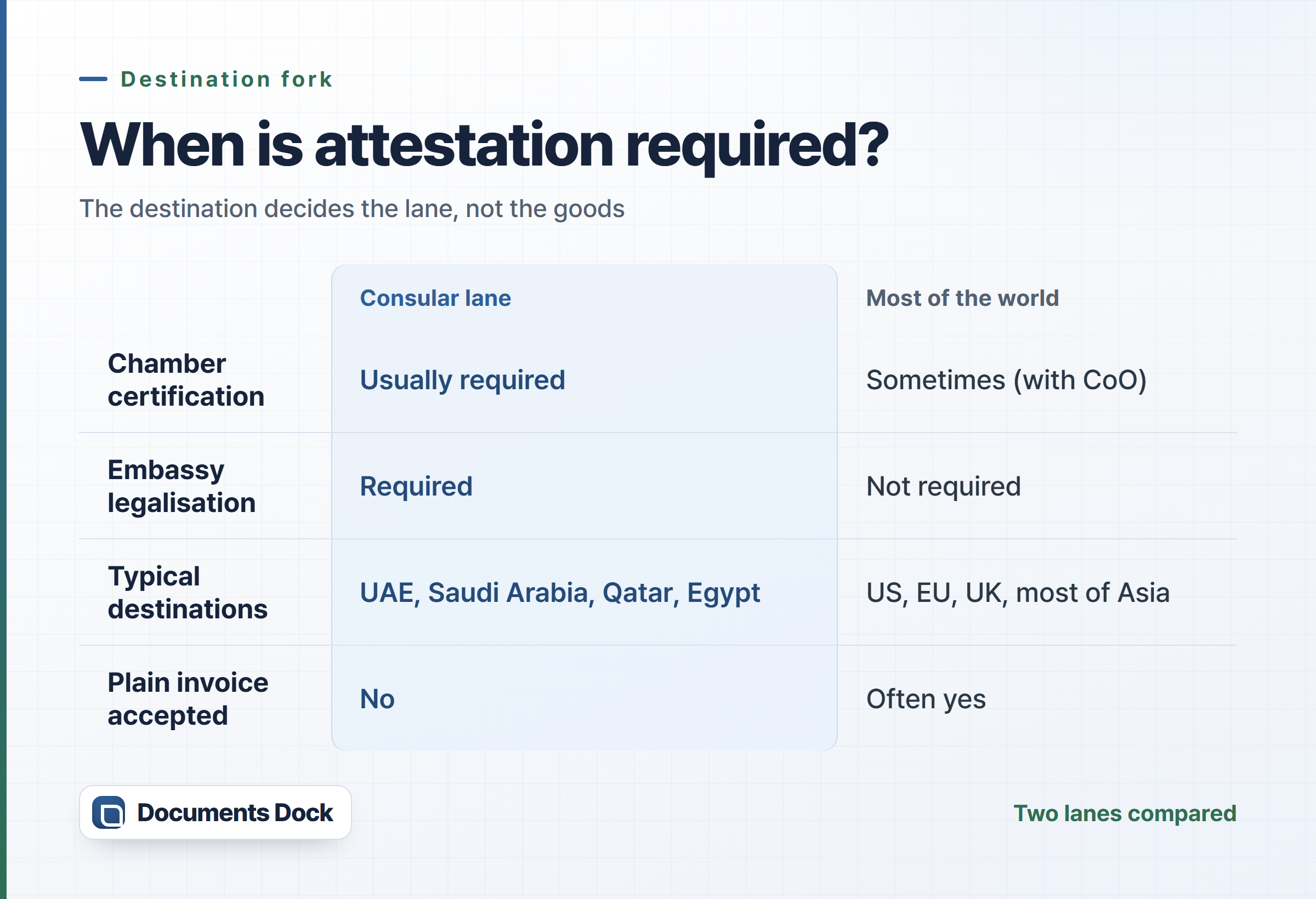
Whether you need attestation depends almost entirely on the destination, not on the goods. Two broad lanes decide it.
The consular lane covers much of the Gulf and Arab League — the UAE, Saudi Arabia, Qatar, Kuwait, Oman, Egypt and several others. These destinations commonly require the commercial invoice, and often the certificate of origin alongside it, to be certified by a chamber of commerce and then legalised by their own embassy or consulate in your country.
The most-of-world lane covers the United States, the European Union, the United Kingdom and most of Asia. Here a plain commercial invoice is accepted for customs. A chamber-certified certificate of origin may be asked for to claim a preferential tariff, but the invoice itself is not embassy-stamped.
Requirements shift, and some Gulf states have moved parts of the process online. Confirm the current rule with the destination's embassy or a licensed customs broker before you commit to a lane.
The deciding question
It is the country the goods are going to — not what is in the box — that decides whether your invoice needs attesting.
Who stamps a commercial invoice, and in what order?
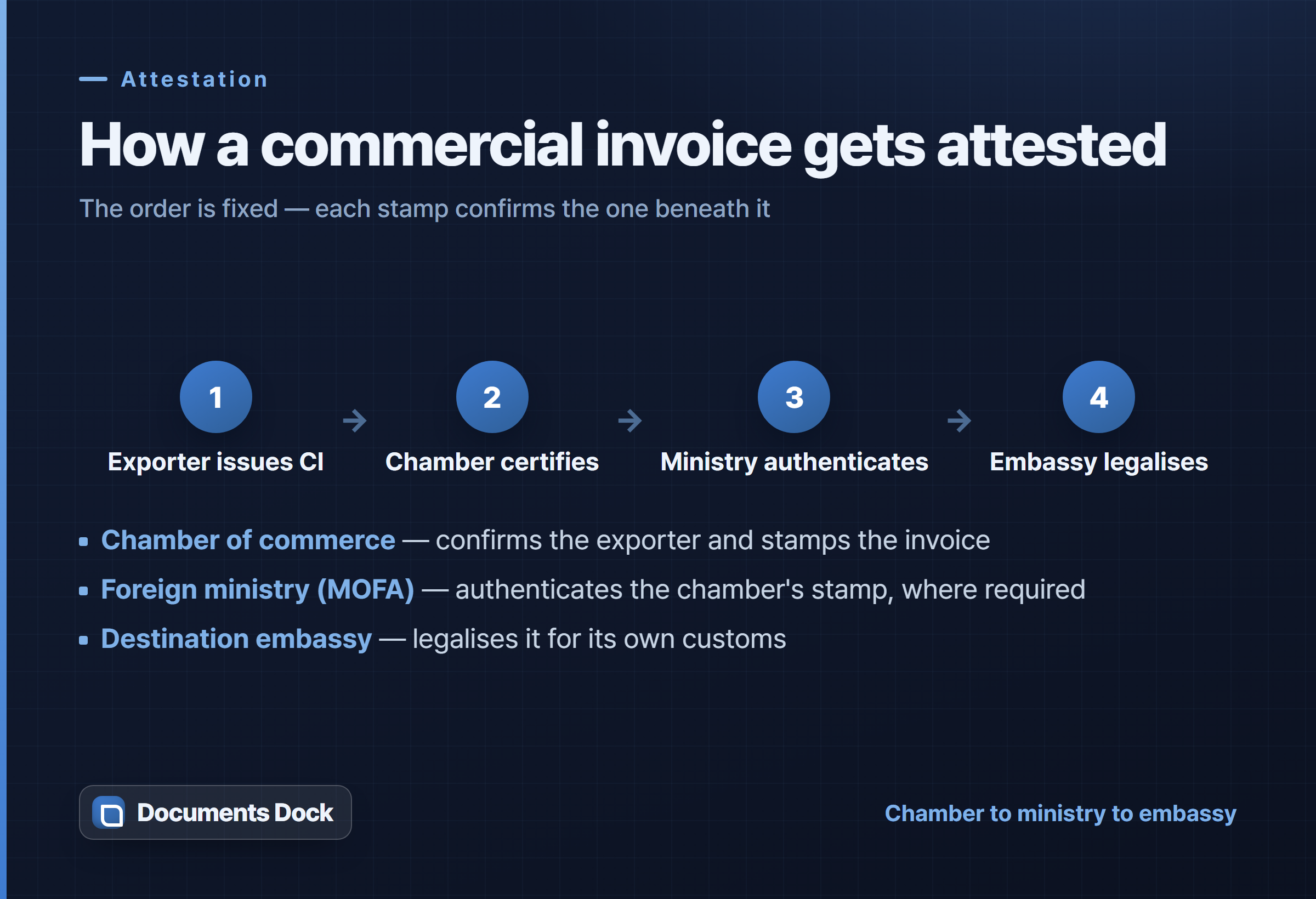
Three parties can touch an invoice on its way to attestation — a chamber of commerce, your country's foreign ministry, and the destination's embassy — and the sequence is fixed.
First, you issue the final commercial invoice. Second, a chamber of commerce certifies it, confirming that you are a registered exporter and that the document is genuine; this is the attestation at source. Third, for many consular lanes your Ministry of Foreign Affairs authenticates the chamber's stamp. Fourth, the destination country's embassy or consulate legalises the invoice — the stamp its own customs will recognise.
Between members of the Hague Apostille Convention, a single apostille can replace embassy legalisation for public documents. A commercial invoice is a private commercial document, so it usually still routes through a chamber of commerce first; whether an apostille is accepted in place of consular legalisation is a question for the destination authority.
- Exporter — issues the final commercial invoice
- Chamber of commerce — certifies that the exporter and the invoice are genuine
- Foreign ministry (MOFA) — authenticates the chamber's stamp, where required
- Destination embassy or consulate — legalises the invoice for its customs
Legalisation, defined
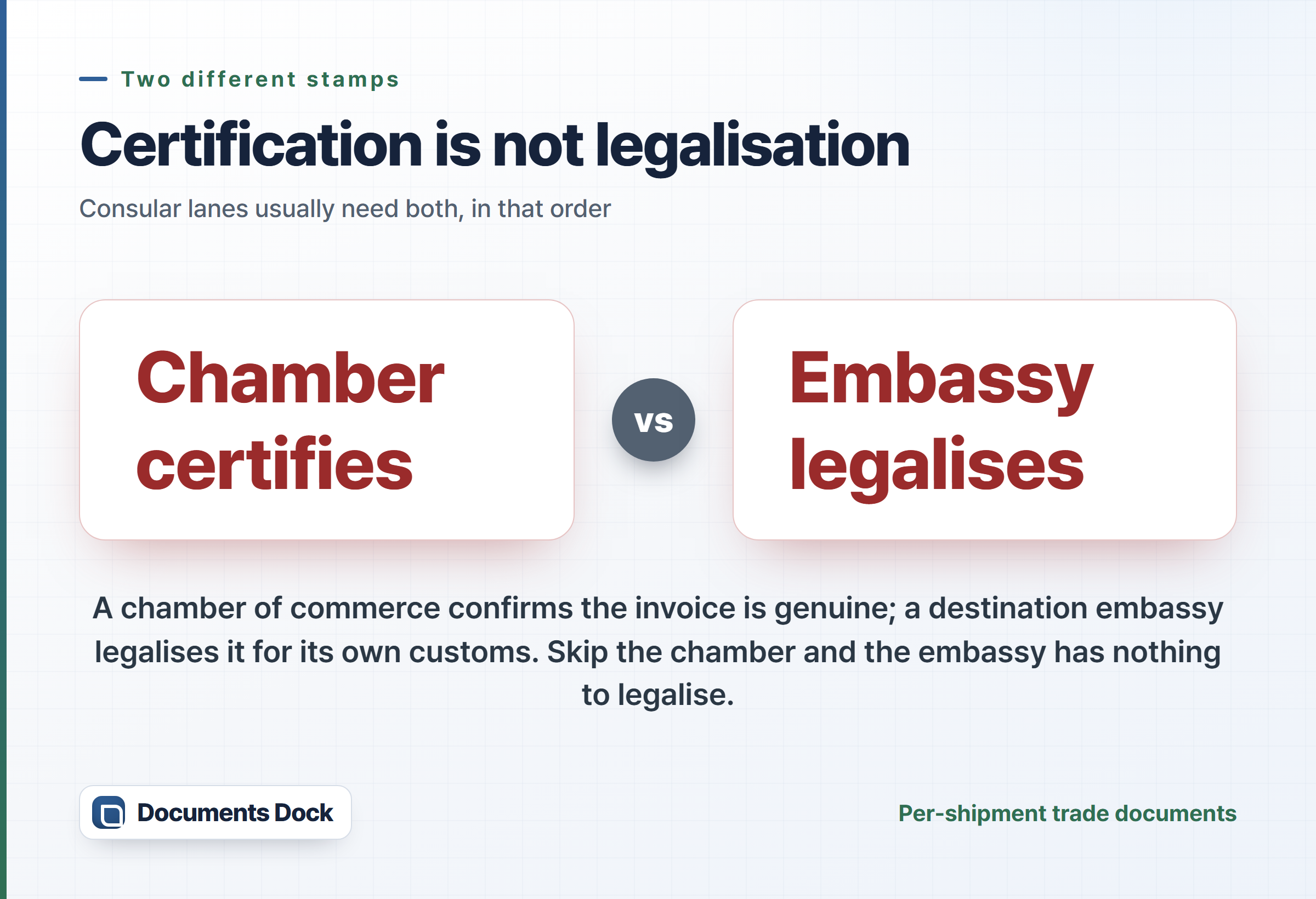
Legalisation is the destination country vouching, through its embassy, that the stamps already on your invoice are ones it trusts.
Before you send an invoice for attestation
Attestation is slow and paid per document, so the preparation matters more than usual. A few checks stop you paying for the chain twice.
Above all, attest the final invoice, not a draft. If you correct a value or a description after legalisation, the corrected invoice has to go through the whole chain again — chamber, ministry, embassy — with the fees and days that involves.
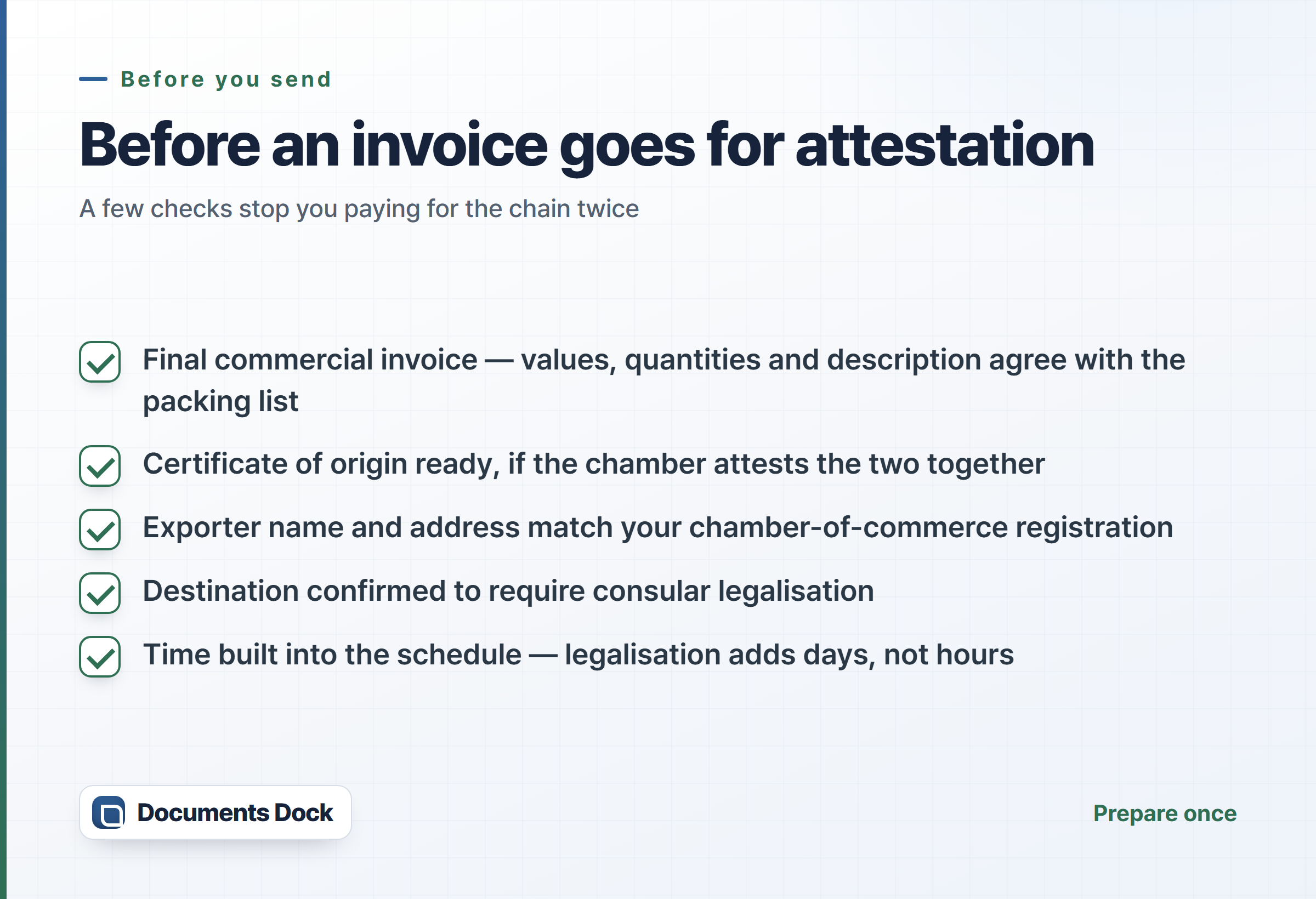
- Final commercial invoice — values, quantities and description agree with the packing list
- Certificate of origin ready, if your chamber attests the two together
- Exporter name and address match your chamber-of-commerce registration exactly
- Destination confirmed to require consular legalisation for this shipment
- Time built into the schedule — legalisation adds days, not hours
Attest once
A value corrected after legalisation reopens the whole sequence. Lock the invoice before the first stamp.
What happens if the stamps are missing or out of order?
If a consular-lane invoice arrives without the required legalisation, the goods wait. Customs at the destination holds the consignment until the stamped invoice follows, or the importer arranges local attestation after arrival — usually at a premium, and sometimes with a fine.
The order cannot be shortcut either. An embassy will not legalise an invoice a chamber has not certified first, because its stamp is a confirmation of the stamp beneath it. Skip the chamber and the embassy has nothing to legalise.
A border hold here is a missing stamp, not a wrong figure — the invoice is complete, it just has not been vouched for. Set beside the other things a border checks first, in what to check when a shipment is held at customs, an absent legalisation is simply one more box left unticked.
Where attestation fits in your document set
Attestation is not an extra document. It is a property some destinations attach to documents you already produce — chiefly the commercial invoice and the certificate of origin. Seen that way, it belongs inside your normal export document set rather than beside it.
So the groundwork is ordinary: a clean, final invoice that agrees with the rest of the bundle, produced early enough to survive a few days of stamping. Get the document right first — the stamps only confirm what is already there.
Documents Dock keeps your commercial invoice, certificate of origin, and issued copies together per shipment, so the version you send for attestation is the final one.
This is general information. Whether attestation applies, and exactly which stamps a destination requires, depends on your goods, countries, and terms — confirm with a licensed customs broker or the relevant embassy.
Sources
International Chamber of Commerce (ICC) — Certificates of Origin (iccwbo.org). Hague Conference on Private International Law (HCCH) — Apostille Convention (hcch.net). UAE Ministry of Foreign Affairs — attestation services (mofa.gov.ae). U.S. International Trade Administration (trade.gov) — export documentation and legalisation.